How Math Gaps Actually Form
The kid who was fine, until she wasn't.
She did her homework. She got 90s. The teacher said she was "right on track." And then, somewhere between the start of 6th grade and the middle of 8th, something quietly changed. Word problems started taking longer. Fractions felt harder than they used to. Algebra arrived and the floor seemed to tilt. Nothing dramatic, just a slow accumulation of "I don't really get this anymore."
If you have watched this happen, you are not imagining it. Math gaps don't appear from nowhere. They form quietly, over years, in places no test was looking. By the time anyone names them, they have already been there for a long time.
This is what those gaps actually are, why they form, and what to do once you can see them.
Quick answer
Math gaps form in four mostly invisible ways. A student can get the right answer for the wrong reason (false mastery), do a skill some days and not others, be fluent in a practiced context but lose it in a new one (fluent but fragile), or look proficient only with help that quietly carries them. All four look like learning on a worksheet. None of them survive the move from arithmetic to algebra. Math is cumulative; a 5th-grade fraction skill that is not yet secure becomes a 7th-grade ratio gap, and by 8th grade algebra is much harder to work around. The fix isn't more practice. It's finding the missing prerequisite skills and building them back.
What parents usually notice first.
Long before there is a score to point at, there are smaller signals. Homework that used to take ten minutes now takes forty. The student who explained things at the dinner table stops volunteering. "I used to be good at math" appears in the same sentence as a shrug. A test grade slips, then another. The reaction is rarely panic. It is closer to a quiet uncertainty about whether something has changed.
Most of the time, something has. But the new topic is not the problem. The new topic is the occasion on which an older problem starts to matter.
Math is cumulative.
That is where most of the story starts. Talk to any algebra teacher about their hardest students, and the conversation lands in the same place. The student isn't failing because algebra is hard. The student is failing because something underneath algebra never solidified. Usually fractions. Sometimes proportional reasoning. Often signed-number arithmetic. The new topic is the trigger. The gap is older.
The most-cited evidence for this is a study by Robert Siegler and colleagues, published in Psychological Science in 2012. Working with two large national datasets, one in the U.S. and one in the U.K., they asked which elementary-school skills predict high-school math achievement, even after controlling for IQ, working memory, and family background. The answer in both countries was the same: knowledge of fractions at age 10 was the strongest single predictor of algebra knowledge at 16. Whole-number division was the second strongest. The result has been replicated, and it now sits inside how serious researchers and curriculum designers think about which elementary skills matter most.
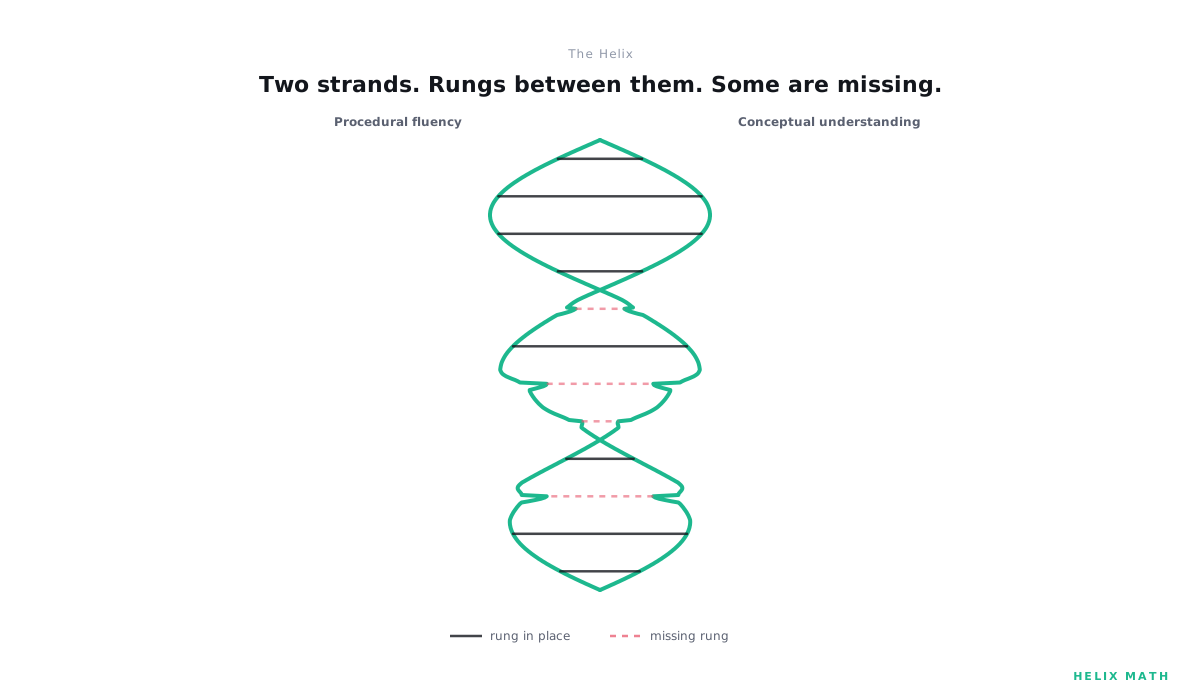
Math is built like a helix. Two strands run alongside each other: procedural fluency on one side, conceptual understanding on the other. Skills are what connect them. A skill in place lets the student reach the next one. A missing skill makes everything built on top of it less secure.
The strands keep going. The student can look like they are climbing. The skill underneath is missing all the same.
The four ways a gap stays invisible.
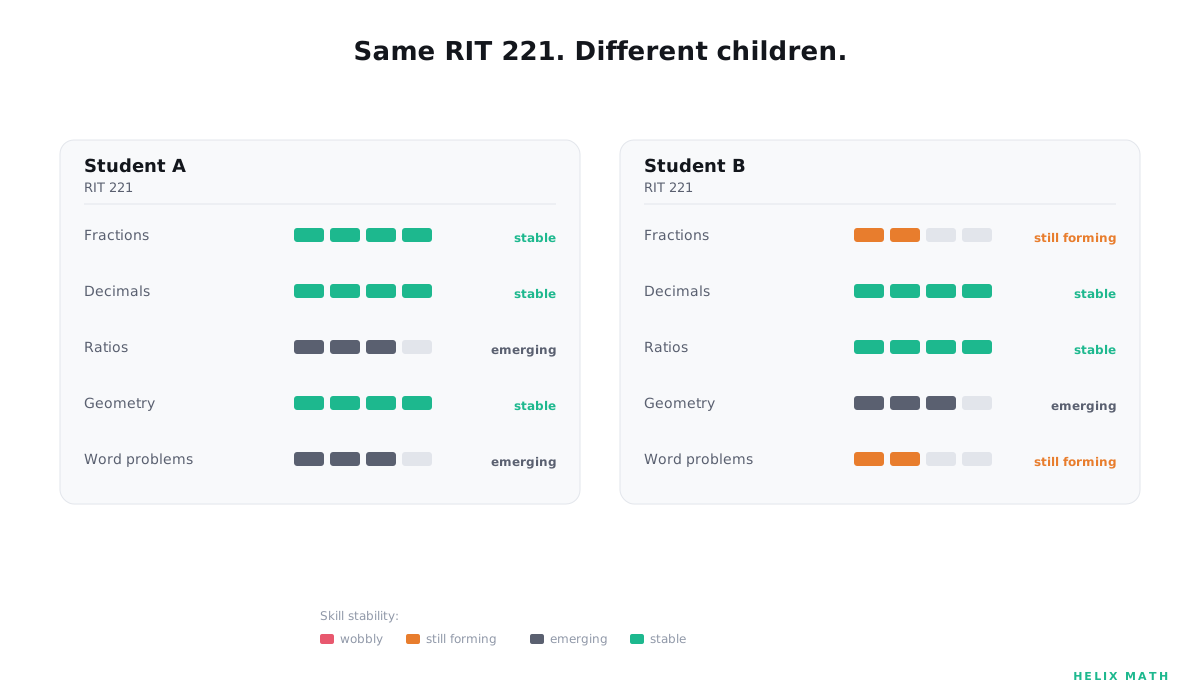
Parents and teachers see math the way every grading system asks them to. Correct or not. Fast or slow. Finished or not. These are the signals we have. They are also exactly the signals a gap can hide behind. Four states look identical from outside, and three of the four are not yet mastery.
| What it looks like | What it actually is |
|---|---|
| Right answers, every time | False mastery |
| Right one day, wrong the next | Skills that are not yet secure |
| Fast and confident on familiar problems | Fluent but fragile |
| Perfect work with help in the room | Help that won't be there on test day |
Right answer, wrong reasoning. A 6th grader multiplies fractions correctly every time. Cross the numerators, cross the denominators, simplify. The procedure runs. Ask her why the result is smaller than each of the original fractions, and she cannot say. The answers were right. The understanding was never built. This is false mastery: the most common way gaps stay hidden, and the one a worksheet cannot see.
There on a good day, gone on a bad day. The same student adds fractions correctly on Monday's homework and misses three of five on Tuesday's quiz. Nothing has changed about the student. The skill is not yet secure, somewhere between built and not built. One correct attempt does not settle it. Five across days might. Skills in this state are the most common reason for those mysterious score swings parents see and assume mean something dramatic. Usually they are noise inside an unsteady skill. (More on this pattern.)
Fast in the practiced setting, broken under transfer. A 7th grader speeds through proportions problems labeled "miles per hour." Hand him the same structure labeled "dollars per kilogram," and he stalls. The procedure is fast. The concept underneath has not generalized. This is fluent but fragile: the loudest of the four mechanisms, because speed and confidence are the signals parents and teachers reward most. Algebra is structurally a transfer test. Fluent-but-fragile skills do not survive it.
Looks like mastery; disappears when the support leaves. The 8th grader's homework is impeccable. The parent has been at the kitchen table every night. The tutor previews each item type before the unit test. The AI chatbot fills in the steps. Each support is real. The performance happens, in the moment, for a real reason. None of it leaves the room with the student. When the supports go, the skill does too. This is help that won't be there on test day, and in an AI-rich world it is the most modern form of the gap problem.
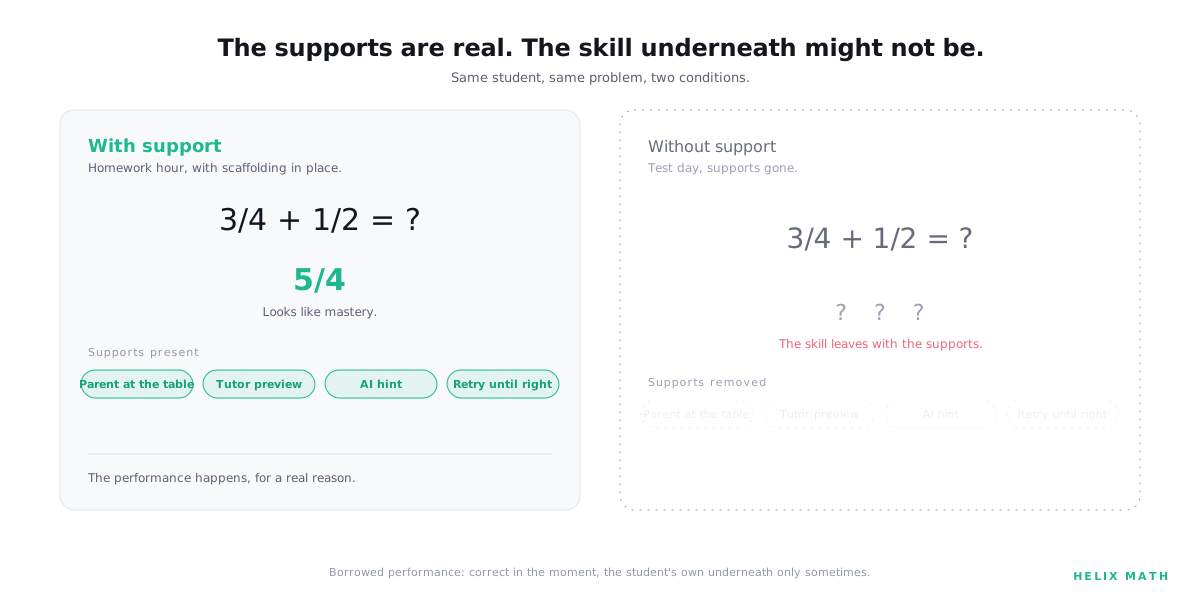
Most wrong answers are easy to spot. Most right answers are easy to celebrate. Math gaps live in the middle, in the answers that look correct but won't survive next year. The average score hides which kind of answer your child has been giving.
Why this keeps happening.
If gaps formed once and then stopped, the school system would have closed them by now. They keep forming because the way we measure learning rewards the very habits that produce them.
Working memory is small. Cognitive scientists have studied its limits for decades; the current best estimate is that adults can hold roughly four chunks of novel information in mind at once, give or take. Children's working memory is smaller. A student solving a new kind of problem is running a search through limited mental capacity, and most of that capacity is spent on the search itself. When the load is high enough to consume working memory, what is left for building long-term understanding is small. The student can land on the correct answer using trial and search, and produce nothing durable.
The takeaway for parents: a student can land on the right answer while building almost nothing underneath it.
This is the territory of John Sweller's cognitive load theory, which has shaped instructional design for forty years. Its most useful practical finding is worked examples: studying a fully solved problem before practicing produces more learning than equivalent practice from scratch, especially for novices. The reason is structural. Worked examples remove the search step that consumes working memory. Practice from scratch leaves the search step intact, and learning happens only around the edges of it.
Another piece of the puzzle is what Henry Roediger and Jeffrey Karpicke documented in 2006 about the feeling of learning. They had university students study prose passages, then either restudy or self-test on the material, with no feedback. On a test five minutes later, the restudy students remembered more. On a test two days or a week later, the testing students remembered substantially more. The interesting part: the students themselves consistently predicted that restudy would work better. Restudy feels like learning. Retrieval feels harder, less complete, less efficient. The feeling is wrong. The students who felt more confident learned less.
Restudy feels like learning. Retrieval is learning. The two are not the same activity.
This pattern shows up everywhere in math. The student who rereads the notes. The kid who watches the teacher work the example a second time. The homework that gets done with a parent's hand visible on the work. All of these produce a feeling of fluency that does not survive the next day. They also produce real, in-the-moment correctness, which is what every grade book records.
James Hiebert and Douglas Grouws, in a 2007 review of what actually improves math achievement across the published evidence, came back with a short list. Two features show up consistently. Explicit attention to mathematical connections, where procedure is taught alongside the concept it rests on. And sustained student struggle with important mathematics, the effortful kind where the student is working at the edge of their current understanding. The first prevents false mastery. The second prevents skills that only hold up with help. Both are slower than the alternatives. Both are what builds skills that hold.
Fractions are the fault line.
If gaps could form anywhere, they would not be predictable. They are. The same skills surface as load-bearing across every cohort, every school, every country in which the question has been asked.
Fractions are the first concept in elementary math where memorization stops working. Whole-number arithmetic has a sturdy intuition underneath; most children build a concept of "how much" without anyone teaching it explicitly. Fractions break that intuition. Three-quarters is not three of anything until the meaning of equivalence lands. Once a student is reasoning by procedure alone, the algorithms work for a year or two and then stop working the moment ratios arrive.
Ratios are fractions in a new costume. Proportions are ratios in another. Slope is proportion drawn vertically. Linear equations are slope and proportion in algebraic notation. Each topic depends on the one beneath it for its meaning. If the meaning of equivalence never landed, the meaning of slope never lands either. Procedural fluency carries the student a long way. Conceptual depth is what algebra eventually demands.
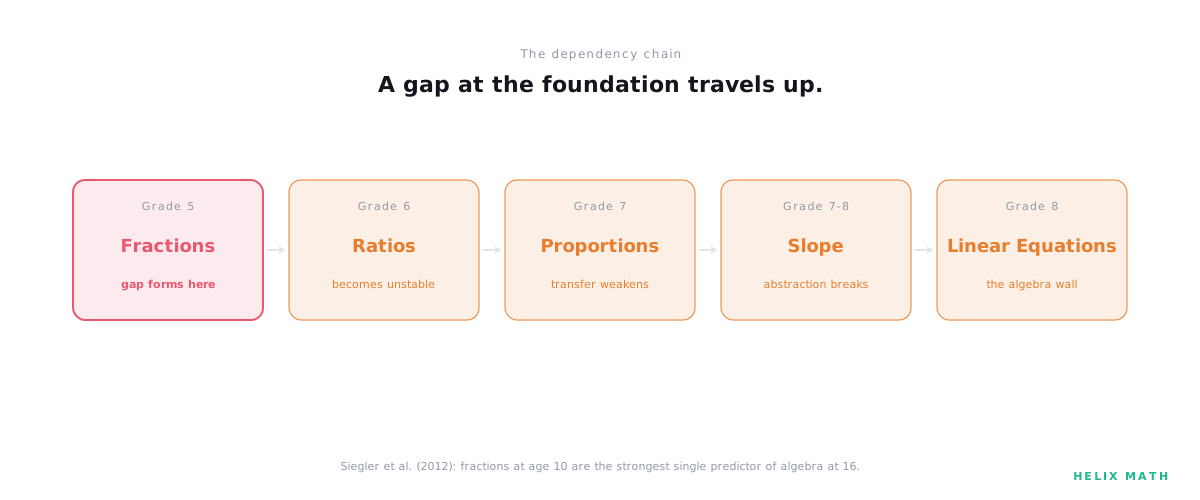
That is why the Siegler result lands so hard. Of all the things measured in elementary school, knowledge of fractions at 10 was the strongest predictor of algebra at 16. Even after controlling for general ability, working memory, family income, parental education, and prior math performance. In both countries studied. By the time algebra arrives, the prerequisite skill has been missing for years. It only becomes load-bearing now.
What you can do.
The instinct, faced with all of this, is to push harder. Buy a workbook. Add a tutor. Add more tutoring. None of that is wrong. None of it is the first move.
The first move is finding which prerequisite skills are missing. A 7th grader stalling on word problems is usually missing a handful of much earlier skills underneath: fraction equivalence, signed-number arithmetic, the meaning of ratio. Not all of them. The three or four that the next two years of math will hang from. For most students in 4th through 7th grade, those skills cluster around fractions, division, ratio, and proportional reasoning. For students further along, integers, expressions, and the meaning of equality each become load-bearing in turn. (Here is a more concrete checklist for spotting the gaps yourself.)
Once the missing skills are named, the practice is short. Fifteen minutes a day, four days a week, on the specific skills that need review. Not random worksheets. Not the chapter the class is in. The skills underneath, until they hold. Cognitive science is consistent about what this practice looks like: short, distributed, retrieval-based, varied enough to force the student to choose a strategy. Not entertaining. Not gamified. Just steady.
The hard part is the first step. The signal a parent has is the score and the report card; the signal that matters is which specific skills need review, are fluent-but-fragile, falsely mastered, or only standing with help. Those are not the same signal. The gap between them is the work of an interpretation layer, the thing that sits between the score and the skills.
Math is a double helix. Procedural fluency on one strand. Conceptual understanding on the other. Skills are what connect them.
Find the prerequisite skills that are missing. Build them back.
If you want help finding them in your child's case specifically, the Helix Program is built to do exactly that, across all four ways gaps stay invisible. It begins with a 30 to 40 minute diagnostic and points at the three to four skills that matter most right now. You can read more about the approach at Helix Math.
The good news is that gaps, once visible, close faster than they form. Years of accumulation, weeks of targeted work. The hard part is seeing them. The rest is the work you were already willing to do.
MAP® and RIT® are registered trademarks of NWEA. Helix Math is not affiliated with or endorsed by NWEA.