Anxious about your child's MAP results? Read this first
The envelope came home in the backpack. You opened it at the kitchen counter. Inside: a one-page report, a number (maybe 218, maybe 203), a percentile, some colored bars, and no explanation of what any of it means. Your child is eating a snack. You are Googling "is 218 a good MAP® score for 5th grade" and getting nine conflicting answers. Feeling anxious about MAP results is the normal reaction to a report designed for teachers, not parents.
The short answer
- A MAP score is a snapshot of current skill on a general math construct, not a report card, not effort, not a prediction of the future.
- The number alone (218, 203, 221) is almost meaningless without grade, term, and growth context, and even with all three, it does not name which specific skills are shaky.
- Two students can score the same RIT® for completely different reasons. The report shows status. The gaps stay hidden.
- Below: three things NOT to do tonight, and three things that actually help.
The number alone does not mean what you think it means
The RIT score measures current skill on a general math construct. It is not a report card. It is not pass/fail. It is not a measure of intelligence or effort. It is not a prediction of college.
Without grade, term, and prior score, the number is almost meaningless. A 215 in 4th grade fall sits near the 60th percentile, above typical. The same 215 in 6th grade spring is below the 25th percentile. The RIT did not change. The reference population did.
The percentile layer, if your report includes it, adds peer comparison. A 60th percentile means your child outscored 60% of same-grade peers in the national norming sample. That is not the percent of questions they got right. MAP is adaptive: items target the student's ability level, and percent-correct hovers around 50% by design (NWEA Family Report).
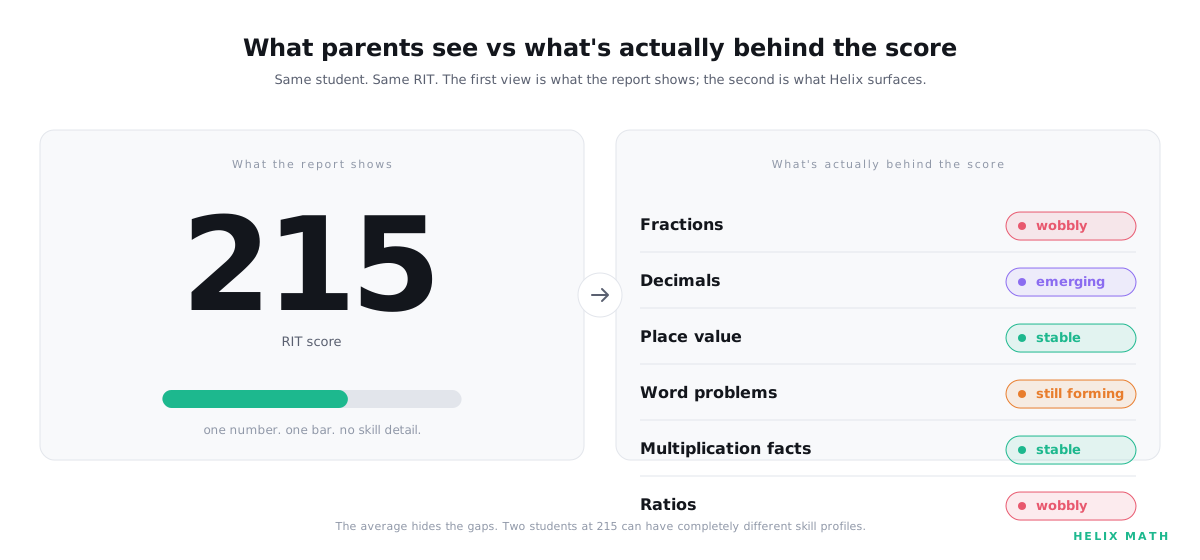
But the percentile still does not name which specific skills are stable and which are still forming. A 50th-percentile student is not uniformly "average" across all of math. They might be fluent in computation but shaky on fractions. Strong in geometry but emerging on proportional reasoning. The average hides the gaps.
What the report will not tell you
The Family Report shows overall RIT, percentile versus grade-level peers, and sometimes goal scores by strand: Operations and Algebraic Thinking, Geometry, Measurement and Data. It does not tell you whether the gap is in fluency (can't recall facts), understanding (doesn't know what division means), or application (can't unpack a word problem).
The strand-level scores have wide confidence intervals because each strand contains far fewer items than the overall score. NWEA explicitly cautions that goal scores are not precise enough to guide daily practice (NWEA: Reliability and accuracy).
The report tells you a 215. It does not tell you whether the gap is fractions, decimals, or proportional reasoning.
This matters because what you do this week depends entirely on which skill is shaky, not on the overall number.
What NOT to do tonight
Three absolute bans.
Do not quiz your child on the ride home or over dinner. They spent 50 minutes on an adaptive test. They are done. If they are not anxious, do not make them anxious by hovering over the number.
Do not compare their score to a sibling's, a friend's, or a number from a parent Facebook group. RIT scores are only comparable within the same grade and term. A 4th grader at 210 and an 8th grader at 210 are at the same point on the construct, but the 4th grader is above typical and the 8th grader is well below. Cross-grade comparisons measure nothing.
Do not Google "is a 215 a good MAP score" and trust the first forum thread. The answer is always "it depends," and the forum will either reassure you when it shouldn't or panic you when it shouldn't. A number without grade and term is noise.
What you can do this week
Three productive moves.
Wait 24 hours before deciding anything. Let your own nervous system settle. The report is not an emergency. MAP is an interim assessment, not an accountability test. It was designed to inform instruction over time, not to trigger a crisis response from a single data point.
Ask the teacher one specific question: "What does this score mean for [child's name] specifically?" Not "Is this good?" Ask what it means for the actual math work in your child's classroom. If the teacher says "on grade level" or "doing fine," follow up: "Are there any specific skills you've noticed are shaky?" Teachers see the day-to-day work. They often know more than the report.
Look at the prior score and calculate the growth. Typical fall-to-spring math growth varies by grade. Kindergarten: about 17 RIT points. 1st grade: 16. By 4th grade: 13. By 5th grade: 10. In 7th and 8th: 7 points (NWEA 2025 Norms). Gains of 8+ in grades K–4 or 5+ in grades 5–8 are typical or better.
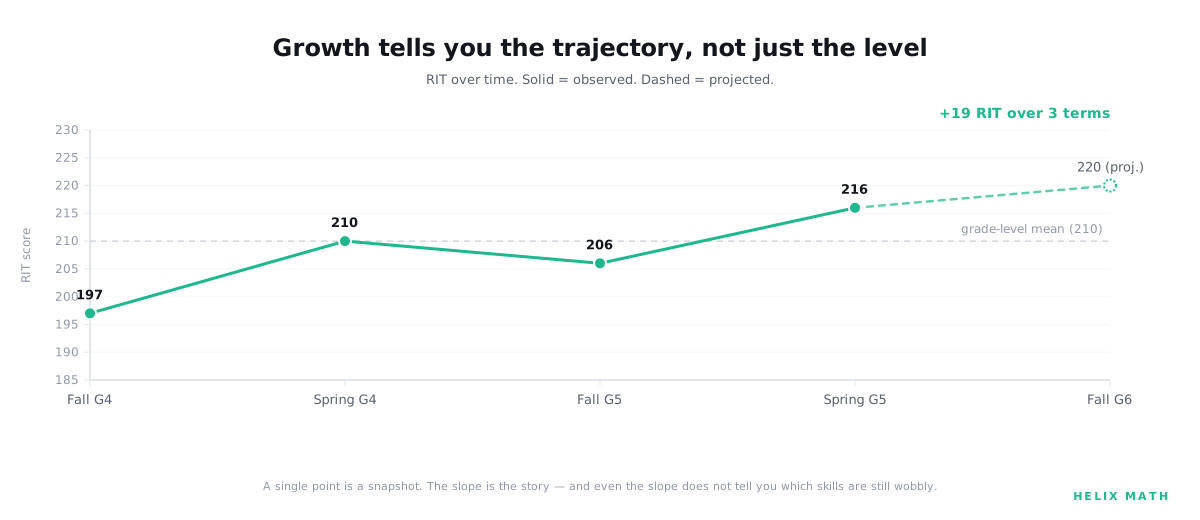
MAP tells you the score. Helix tells you the skills behind it.
If the score dropped, and this happens more often than parents expect, check the Student Profile Report for rapid-guessing flags. If more than 30% of items were rapid-guessed, the score is not valid; a retest is appropriate. A 2- or 3-point drop with no flags may just be measurement noise: MAP's standard error is roughly 3 RIT, so the true score has a 68% chance of falling within ±3 of the observed (NWEA: Standard error of measurement).
When you should actually pay attention
Four signals worth a closer look.
RIT dropped AND there were no rapid-guessing flags. A real drop, more than 5 points, is unusual and worth a teacher conversation. It may reflect a curriculum gap, an unconquered concept, or test anxiety.
RIT is below the grade mean AND homework is a nightly battle. The score is confirming what you already see. NWEA's bands classify scores below the 21st percentile as "Lo" and 21st–40th as "LoAvg." If your child is in either and homework is a fight every night, specific skills are not yet stable.
The teacher has flagged gaps in fractions, decimals, or word problems AND the percentile is below 40. Teacher observation plus low percentile is stronger than either alone. The teacher names what is shaky. MAP confirms it is not one bad week.
Your child switched schools or curricula mid-year. Common for international school families. If you moved US-curriculum to IB, or Cambridge to CCSS, MAP may underestimate readiness because your child has not yet been taught the topics MAP samples this season. The score reflects exposure as much as skill.
In all four cases, the next step is not more drill. Most practice tools tell you whether the answer was correct, not whether the underlying skill is stable. The next step is finding out which specific skills need review, so practice can be targeted. That is what Helix Math was built to do. The Helix Program begins with a 30 to 40 minute diagnostic that maps the skills behind the number, one at a time.
The MAP report is the start of a conversation, not the end of one. It gives you a number and a percentile. It does not give you the list of skills to practice. That list comes from observation, teacher feedback, and (if you need it) a diagnostic that breaks the number into its parts.
A single MAP score does not define your child's math trajectory. It is one measurement, on one day, under one set of conditions. What matters more is what happens in the weeks after the report comes home. Whether you wait and observe. Whether you ask the right questions of the teacher. Whether you find the specific gaps and fill them, or whether you practice randomly and hope.
The number told you where. It did not tell you what comes next. You have time.
MAP® and RIT® are registered trademarks of NWEA. Helix Math is not affiliated with or endorsed by NWEA.