Is 221 a Good MAP Math Score? Percentile by Grade and Season
Your child scored a 221 on the MAP® math test. The report shows a green bar. The homework shows tears. To see where a 221 lands at every grade and season, start with MAP math scores by grade, including typical 6th grade scores.
The short answer
- A 221 math RIT® is above the median for 5th grade spring (mean 216), at the median for 6th grade fall (mean 210), and below the median for 7th grade fall (mean 217) under 2025 norms.
- It typically reflects mastery of early fraction computation, decimal place value, and introductory ratio concepts, roughly late-5th to early-6th grade content.
- Two students can score 221 for completely different reasons: one strong on fractions but needing review on decimals, the other the opposite. The MAP report averages these into one number.
- Read on for what a 221 actually hides, and how to figure out which specific skills your child has secured and which are still developing.
What this score means by grade
A MAP math RIT of 221 sits at about the 48th percentile for grade 8 in fall, inside the typical range for that grade (210 to 234). The same number means something different at every grade and season, which is what the table below shows.
| Grade | Fall | Winter | Spring |
|---|---|---|---|
| Grade 2 | 99th | 99th | 98th |
| Grade 3 | 99th | 96th | 90th |
| Grade 4 | 93rd | 84th | 73rd |
| Grade 5 | 83rd | 70th | 61st |
| Grade 6 | 75th | 62nd | 52nd |
| Grade 7 | 59th | 50th | 44th |
| Grade 8 | 48th | 40th | 34th |
A 221 sits at or above the 99th percentile for Grade 1 and below, so those grades are left out of the table above.
Percentiles are calculated from NWEA 2025 MAP Growth math norms (publicly published Quick Reference). A percentile says where a score sits against same-grade peers. It does not say which specific skills are secure and which need review; only a skill-level check can do that.
What a 221 math RIT actually means (by grade)
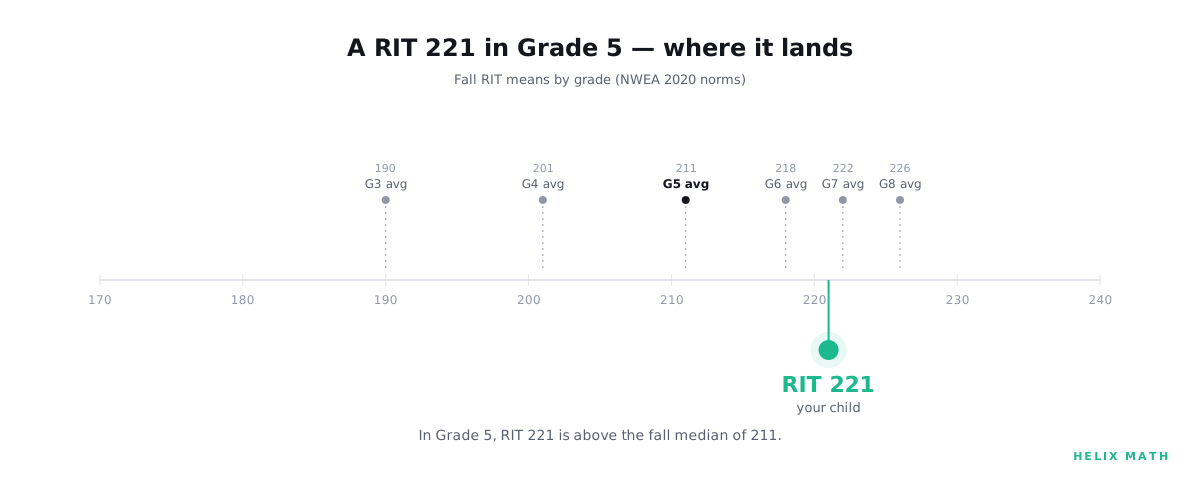
A 221 is not good or bad. It is a point on a scale that spans kindergarten through high school. What it means depends entirely on which grade your child is in and when they took the test.
Under the 2025 MAP Growth norms, here is where a 221 sits:
| Grade | Fall Mean | Spring Mean | Where 221 sits |
|---|---|---|---|
| 4 | 197 | 210 | Well above median (spring: ~67th percentile) |
| 5 | 206 | 216 | Above median (spring: ~62nd percentile) |
| 6 | 210 | 220 | Near median (fall: ~63rd / spring: ~47th) |
| 7 | 217 | 224 | Below median (fall: ~41st percentile) |
| 8 | 222 | 229 | Below median (fall: ~37th percentile) |
A 221 in 5th grade spring is above the typical peer. A 221 in 7th grade fall is below. The RIT itself did not change. The reference population did.
The average hides the gaps.
This is why the percentile matters more than the RIT alone.
The percentile compares your child to same-grade peers in the norming sample: 13.8 million students across 30,000 schools. A percentile of 60 means your child outscored 60% of those peers at that grade and season.
But even the percentile does not tell you which specific skills are secure and which are still developing. We have written more on how to tell if your child has math gaps when the report says one thing and the homework says another.
What math content a 221 typically covers
A 221 generally reflects mastery of late-elementary and early-middle-school math content. The skills cluster around:
- Adding and subtracting fractions with unlike denominators (5.NF.A.1)
- Multiplying fractions by whole numbers (5.NF.B.4a)
- Reading, writing, and comparing decimals to thousandths (5.NBT.A.3)
- Understanding ratio concepts and using ratio language (6.RP.A.1)
- Solving unit rate problems (6.RP.A.2)
- Dividing fractions by whole numbers (6.NS.A.1, introductory)
A 221 does not mean your child has mastered every fraction skill or every decimal skill. MAP estimates broad readiness. It does not surface specific gaps.
This is exactly where parents get stuck. The score tells you roughly where your child is. What to practice next lives at a different resolution. That is the layer Helix Math was built to explore.
The Family Report also shows strand-level "goal scores": sub-RIT scores for Operations and Algebraic Thinking, Number and Operations, Geometry, and so on. These are useful signals, but NWEA warns that goal scores have wider confidence intervals than the overall RIT because each strand contains far fewer items. Treat them as directional, not as a skill-by-skill inventory.
Why the same score can hide completely different gaps
Two students can score the same 221 for completely different reasons. This is the part of MAP that parents almost never understand until they see it in their own child's homework.
Student A: 6th grade fall, RIT 221
- Strong on multiplying and dividing fractions (5.NF.B)
- Fluent on decimal place value and comparing decimals (5.NBT.A)
- Needs review on ratio reasoning (6.RP.A), struggles with unit rates, ratio tables, percent problems
Student B: 6th grade fall, RIT 221
- Strong on ratio tables and unit rates (6.RP.A)
- Comfortable with percent benchmarks (10%, 25%, 50%)
- Needs review on dividing fractions by whole numbers (6.NS.A.1)
- Needs review on fraction-decimal equivalence (4.NF.C.5-7), can convert 1/2 to 0.5, but not 3/8
Both students earned a 221. Both sit at roughly the 60th percentile for fall of 6th grade. But Student A needs targeted ratio practice and Student B needs fraction-division fluency. The MAP report averaged their strengths and gaps into one number. It did not tell you which skills were secure and which needed review.
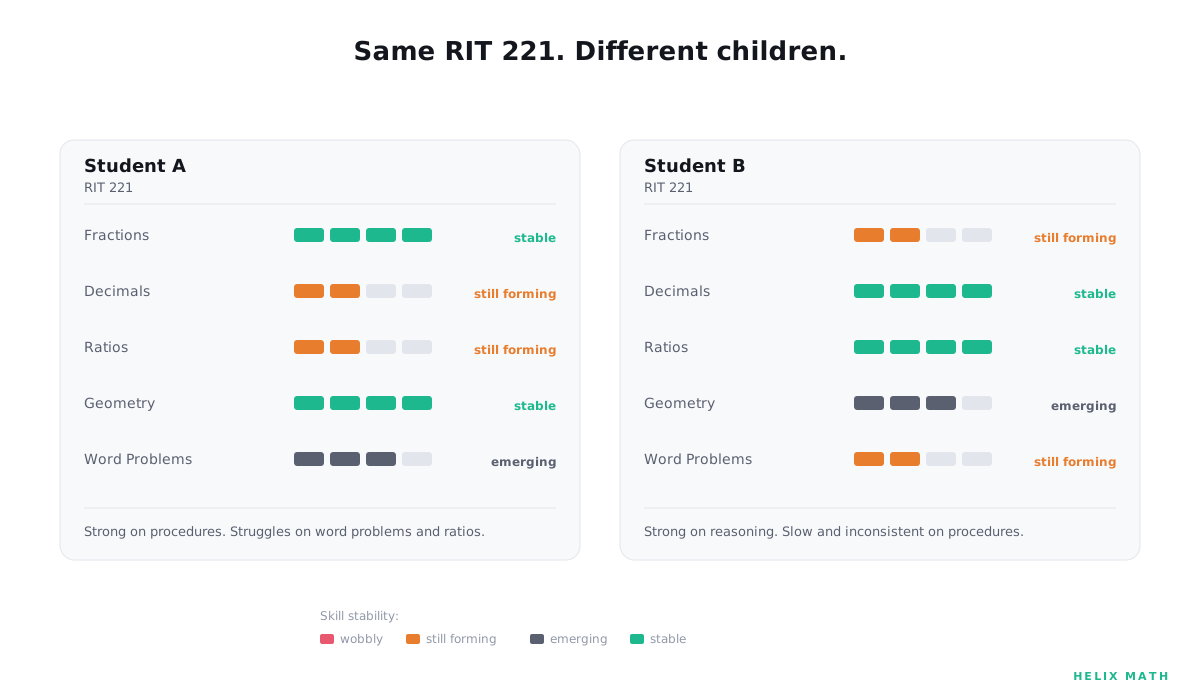
The MAP report tells you a 221. The skill-level picture (whether the skill that needs review is fractions, decimals, or proportional reasoning) lives at a different resolution than MAP was designed to measure. We map that gap in what MAP scores don't tell you.
This is not a flaw in MAP. MAP was built to measure growth on a general math construct, not to itemize every missing skill. The Family Report gives you a score and a percentile. It does not give you a skill-by-skill inventory.
After a 221: five concrete next steps
A 221 is a data point. It is not a verdict. Here is what to do in the next seven days:
1. Look at the percentile, not just the RIT. The percentile tells you how your child compares to same-grade peers. A percentile between 40 and 60 is typical. Above 60 is above-typical. Below 40 means your child is growing more slowly than most peers at that grade.
2. Check the strand-level goal scores on the Family Report. If one strand is 10+ RIT points lower than the others, that is a signal. It is not proof (the confidence interval on a goal score is wide), but it tells you where to ask questions.
3. Ask the teacher which units your child struggled with this term. The classroom observation beats the number. If the teacher says "fractions were hard but ratios clicked," you have actionable information the MAP score did not give you.
4. If your child is not anxious about the number, do not make them anxious by asking what it means at the dinner table. The score is a snapshot, not a verdict. It measures current skill under standard test conditions. It does not measure effort, potential, or worth.
5. If you want to know which specific skills need review, a targeted diagnostic maps the underlying construct one skill at a time. Two students at the 60th percentile can need completely different practice. For a quick look first, the free grade 6 MAP math practice problems sample ratios, the number system, expressions and statistics in fourteen questions, and take about fifteen minutes with no sign-up. The Helix Program goes further: it begins with a 30 to 40 minute diagnostic showing which specific skills your child has secured and which are still developing.
For more on the pattern of a child who understands math in class but fails the test, we have written a full guide.
A MAP score tells you roughly where your child sits on a very long continuum. Which specific skills are secure, which need review, and which missing foundations will create problems later all live at a different resolution than the score was designed to measure. That is the layer between assessment and learning. Helix was built to explore it.
A 221 told you where. It did not tell you what comes next. Now you have somewhere to start.
MAP® and RIT® are registered trademarks of NWEA. Helix Math is not affiliated with or endorsed by NWEA.