What MAP scores don't tell you (and what to do about it)
You have the number now. A 218, a 64th percentile, maybe an arrow pointing up or down from the fall. You have read the one-page explainer the school sent home. And you still cannot answer the question you actually walked in with: is my child okay in math, and if not, what exactly is wrong? That gap between the number and the question is not your fault, and it is not a failure of the test. There is simply a limit to what one number can carry. This is a guide to what MAP® scores don't tell you, why they were never built to, and what to look at instead.
The short answer
- A MAP score is a broad achievement estimate. It tells you roughly where your child sits on a vertical scale and how they compare to peers. Those are real and useful things to know.
- It does not tell you which specific skills are secure and which need review, whether a correct answer came from understanding or recall, or what to work on next.
- This is not a flaw. MAP samples broadly across a whole year of math. It was built to measure achievement, not to inventory one child's skills. The average compresses the gaps by design.
- Two children with the identical score can have nearly opposite skill profiles underneath it.
- What to do instead: read the score as a range, watch the strand bars and growth over time, and get a skill-level picture for the specifics. Read on for each.
On this page
- What the score is genuinely good at
- What a single number leaves open
- Why the test is built this way
- Two children, one score, different gaps
- How a hidden gap travels
- What you can do this week
- The number is a starting point, not a verdict
What the score is genuinely good at
Start with what the number does well, because it does several things well, and the point here is not to find fault with the instrument.
A RIT® score estimates achievement on a vertical, equal-interval scale used across grades and terms. Higher generally means a child handled more difficult math. The scale behaves like a ruler, which is what makes it useful for watching growth across years. A fifth grader at 210 and a seventh grader at 224 sit at different points on the same ladder. The MAP RIT score by grade chart shows where most students land at each grade.
The percentile does a second job: it ranks your child against a national sample of same-grade, same-season peers. A 64th percentile means your child scored higher than about 64 percent of them. And the growth measures do a third: across several terms, they show whether your child is gaining faster or slower than students who started in the same place.
Those are three real, defensible things. Where your child sits. How they compare. Whether they are growing. A school serving hundreds of students needs exactly that kind of broad, comparable signal, and MAP delivers it efficiently. None of what follows is a complaint about the instrument. It is about the question the instrument was not built to answer.
What a single number leaves open
Here is the honest limit. A MAP score is a composite, and a composite is an average, and an average is built to summarize. Summarizing means smoothing. The number tells you the altitude. It does not tell you which specific skills are solid underneath it and which are not yet secure.
That distinction matters more than it sounds. Consider what a single score cannot separate:
- Which skill is the problem. A 218 does not tell you whether the soft spot is fraction division, decimal place value, or ratio reasoning. It reports the altitude of the whole flight, not the one skill underneath that needs review.
- Understanding versus recall. A correct answer and a memorized procedure can look identical on a multiple-choice item. The score cannot tell you whether your child reasoned to the answer or pattern-matched their way there.
- Whether the skill is secure. A skill that works on Tuesday's worksheet and breaks on a reworded problem two weeks later is not yet secure. The score is a single snapshot. It cannot see how a skill holds up across days, contexts, and small variations.
- What to do on Monday. A teacher planning tomorrow's lesson needs to know which skill to reteach. A broad achievement number was not designed to operate at that level of day-to-day instructional detail.
This is the heart of it. The average hides the gaps. A child who is strong in three areas and needs review in one can post a perfectly healthy composite, because the strong areas quietly carry the weaker one. We wrote a whole piece on that mechanism: the average hides the gaps.
The report itself shows the layers, and each layer is a lower resolution than the one below it.
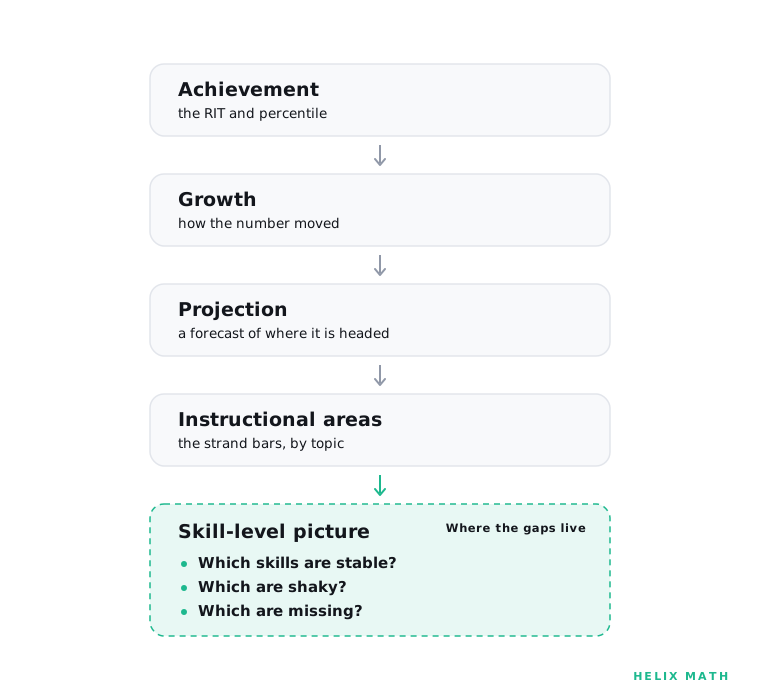
It helps to see the two jobs side by side. One column is what the report is built to show. The other is the layer it leaves to you.
| What a MAP score shows you | What still needs a closer look |
|---|---|
| Roughly where your child sits on a vertical achievement scale | Which specific skills are secure and which need review |
| How that compares to same-grade peers (the percentile) | Whether a correct answer came from understanding or recall |
| Whether they are growing faster or slower than similar peers | Whether a skill holds up when the problem is worded differently |
| When growth stalls across several testing windows | What to reteach, and in what order, this week |
Keep it handy: download the one-page parent guide (PDF).
Why the test is built this way
It is tempting to read the limits above as failures. They are not. They are the direct result of design choices that make MAP good at its actual job.
MAP is adaptive. It adjusts difficulty in real time, targeting roughly 50 percent accuracy, so it can find a child's level quickly with a manageable number of questions. That is why your child misses about half the items and the score is still fine. Missing items is the mechanism, not a warning sign.
It also samples broadly. A single sitting draws items from across a whole year of math, touching many skills lightly rather than any one skill deeply. Because the test spreads its questions across the whole construct, a student may not see enough items within a specific skill to show how reliably that skill holds. The result is an efficient, reliable estimate of broad achievement, and a number that cannot zoom in.
There is also measurement error to respect. A single RIT carries about 3 points of standard error, which means a 218 reflects a true level somewhere in the neighborhood of 215 to 221. As a rough rule of thumb, small changes inside roughly two standard errors usually need more context before they mean anything. A 3-point dip is more often noise than news.
Different instruments operate at different resolutions. MAP was built for broad academic measurement across many students. It was not designed to resolve the day-to-day, skill-by-skill picture of one child. Both are legitimate. They are simply not the same tool, and the trouble starts only when we ask the broad number to do the narrow job.
Two children, one score, different gaps
The cleanest way to feel the limit is to look at two students who score the same.
Picture two sixth graders, both at a RIT of 221, both squarely average for their grade, both sent home with the same encouraging note. Student A is solid in number and operations but needs review in the algebraic-thinking area, where ratios and early variable work live. Student B is the mirror image: ratios come easily, fractions still need review.
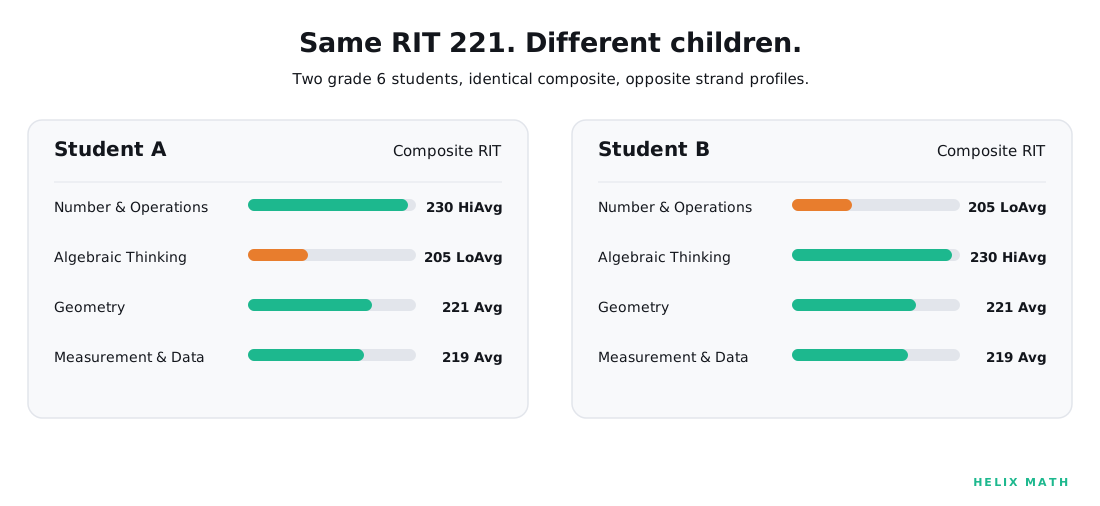
Same composite. Same percentile. Same Learning Continuum statements. The skill profiles underneath are nearly opposite, and they call for nearly opposite work. The number cannot tell them apart, because telling them apart was never its job. This is the recognition every teacher has at a conference: the score says one thing, and the child in front of them is doing something more specific.
How a hidden gap travels
A hidden gap would matter less if math were a pile of independent topics. It is not. Math is a chain, and each link depends on the ones before it.
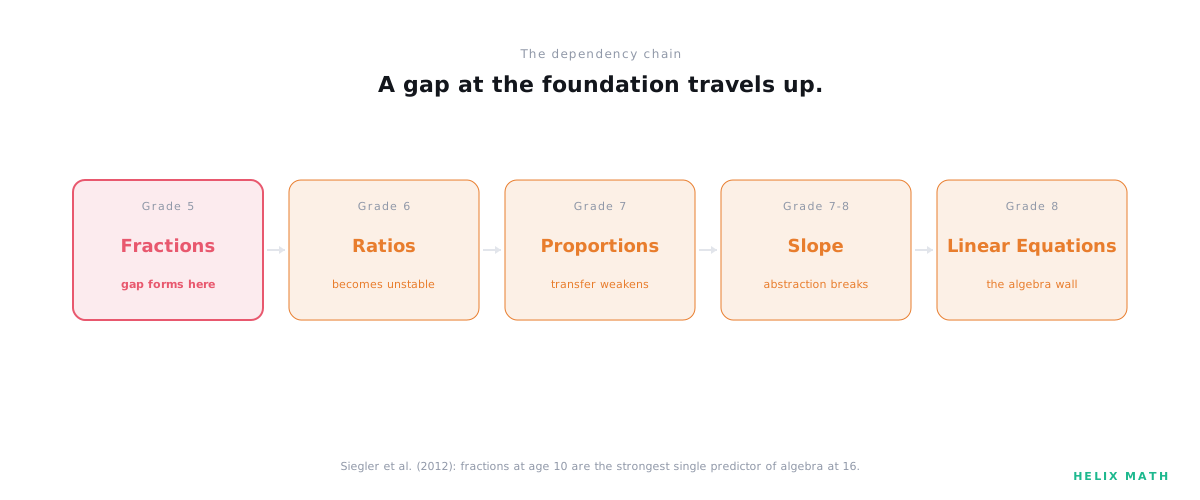
A fifth-grade fraction skill that is not yet secure does not announce itself. It re-emerges as a sixth-grade struggle with ratios, then as a seventh-grade obstacle in proportional reasoning, then as the moment in eighth-grade algebra when nothing seems to click. At each step the composite score can hold reassuringly steady while the specific gap carries forward underneath. By the time it surfaces as a low grade in algebra, the original gap is years upstream. We trace that progression in fractions are the fault line. The earlier you can name the specific skill that needs review, the smaller and cheaper it is to repair.
This is why "the score looks fine" is cold comfort to a parent who senses something is off. The broad score can stay steady while a specific foundational weakness persists. The number is not lying. It is just pointed at a different question than the one that keeps you up at night.
What you can do this week
You do not need to become a psychometrician. You need a few habits that turn the number into something you can act on.
Read the score as a range, not a verdict. A single RIT carries about 3 points of error, which matters most when the number sits just under a placement or gifted cutoff; see what to do when your child missed the cutoff by a few points. If your child moved fewer than about 6 points from the last test, treat it as a possible steady signal rather than automatic news; if it dropped further, walk the likely causes before worrying. Save your attention for trends across three or more terms, not single-test wiggles. The three numbers on the report each answer a different question, and none of them is precise to the point.
Separate "where they sit" from "are they growing." Ask the school for the Conditional Growth Percentile, which compares your child's growth to peers who started at the same place. A child at the 45th percentile who is growing faster than most similar peers is not falling behind, even if the achievement percentile looks modest. We pull these apart in growth, achievement, and rank.
Read the strand bars, gently. If one instructional-area bar sits well below the others across more than one testing window, and it matches what you see at the kitchen table, that strand is worth a closer look. It is a place to start asking better questions, not a verdict. Remember each strand still spans dozens of skills, so it points at a neighborhood, not an address.
Trust the pattern you see at home when it disagrees with the number. If the report says fine but your child melts down over the same kind of problem every week, the number is not wrong, just blunt. That repeated struggle is real, specific data about one skill, and it is more actionable than any percentile.
When you want the specifics, use a tool built for the specifics. The broad score gives you the altitude. A skill-level diagnostic gives you the terrain: which skills are secure, which are still developing, and which need attention now.
The number is a starting point, not a verdict
A MAP score is doing one job, and doing it well. It estimates where your child sits, how they compare, and whether they are growing. Hold on to those. They are worth knowing.
It is not doing the other job. It is not telling you which specific skills are secure and which need review, or what to practice tomorrow. That layer lives at a different resolution, and it is exactly the layer Helix Math was built to surface: which skills appear secure, which are still developing, and which may need attention next. The Helix Program begins with a 30 to 40 minute diagnostic that gives parents a skill-level map underneath the broad score, then suggests a short daily plan focused on the few skills that matter most.
The score told you where your child was standing on one ordinary morning. It did not tell you what they are ready to learn next. That part was always going to take a closer look.
MAP® and RIT® are registered trademarks of NWEA. Helix Math is not affiliated with or endorsed by NWEA.