Why fraction gaps in 5th grade show up later in algebra
Your 5th grader seemed to understand fractions yesterday. Today the same kind of problem feels impossible again. You explain it one more time. They follow the steps for a while, then lose the thread. At that point most parents wonder the same thing: is this just a hard unit, or is something bigger going on?
Often it is bigger. Fractions are one of the main bridges between elementary arithmetic and middle-school math. When fraction understanding is not yet secure, the same gap tends to show up later in ratios, proportions and algebra.
The short answer
- Fractions are one of the biggest turning points in elementary math. They are where students move from whole-number arithmetic toward ratios, proportions and eventually algebra.
- A student can follow fraction rules without fully understanding what the fractions mean. That looks fine on homework and unit tests, and it often shows up later in word problems, ratio tables, proportions, slope and equations with fractions.
- The gap carries forward because each year's math assumes the previous year's fraction skills are already secure. A 5th grader who can "flip and multiply" but cannot explain why will find unit rates harder in 6th, cross-multiplication harder in 7th and rational expressions harder in 8th.
- MAP® scores and report-card grades often do not show it. Getting the right answer by following steps looks like understanding until the problem appears in a new context.
- The earlier you find the specific fraction skill that is not yet secure, the easier it is to strengthen. The goal is not to redo fractions from scratch. It is to identify the exact prerequisite skills your child needs and work on those.
Why fractions are such a turning point
Fractions are the first time math stops behaving like whole numbers. Addition does not always make a number bigger. Multiplication can make things smaller. Two quantities can represent one relationship. A number can be written four different ways and still be the same number.
That is the conceptual shift. Whole-number thinking (count up, count down, the answer is bigger or smaller in the obvious direction) runs out of road. Fractions are where the rules change. And they are the rules that algebra is built on.
Without secure fraction understanding, students can get through worksheets for a while by memorizing procedures, then struggle when 7th-grade ratios and 8th-grade algebra ask for reasoning rather than recipes. The research pattern is well established. A 2012 longitudinal study by Siegler et al. tracked students from 5th grade through high school and found that 5th-grade fraction knowledge was the strongest predictor of algebra readiness and high school math achievement, even after controlling for whole-number arithmetic, IQ, and family background (Siegler et al., 2012). NWEA's own middle-school trajectory work shows students who start 6th grade off-track in math rarely catch up by 8th grade without intervention (NWEA, "Catching up or falling behind").
The gap usually opens in 5th grade. By 8th grade it is much harder to work around.
A MAP score tells you where a student sits on the achievement scale. It does not tell you whether their fraction understanding is secure or simply memorized. Those are different things.
How fraction gaps show up by grade
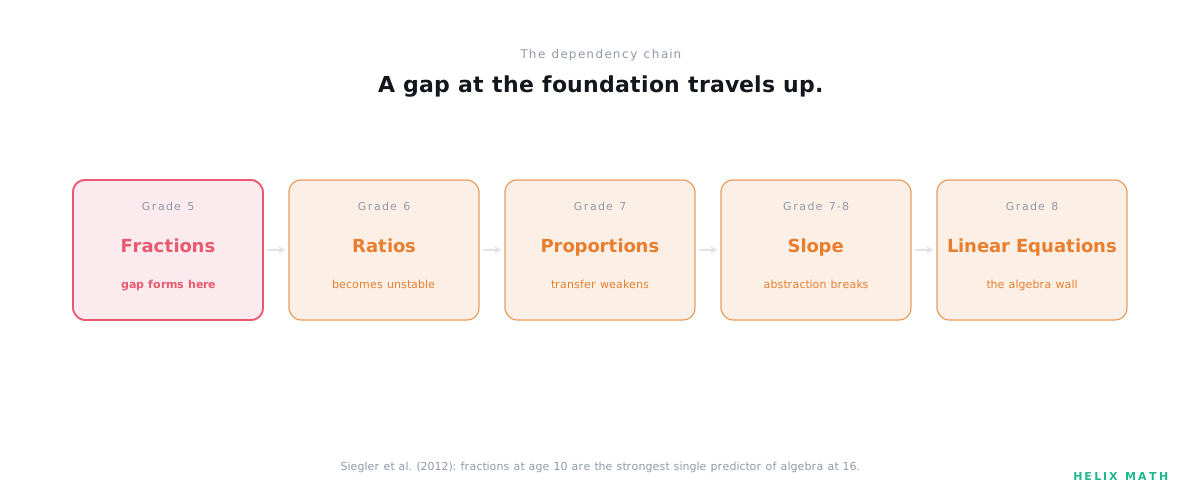
Walk the specific skills. One grade at a time.
5th grade: the foundation
Three skill clusters matter most: fraction equivalence, addition and subtraction with unlike denominators, and multiplication and division of fractions (the 5.NF fractions standards).
If these are not yet secure — correct sometimes, wrong other times, or right for reasons the student cannot explain — they enter 6th grade with a gap that is easy to miss. A 5th grader who can convert 2/3 to 4/6 by following the rule but cannot explain why they are equivalent does not yet have secure fraction equivalence. A 5th grader who can execute "flip and multiply" for 3/4 ÷ 1/2 but cannot place the answer on a number line or explain why division made the result larger does not yet have secure fraction division.
The steps may work for now, but the meaning is not secure yet. That usually stays out of sight until 6th grade.
6th grade: ratios and unit rates
Ratios are fraction thinking in a new form (the 6.RP cluster). A unit rate is a fraction. Proportional relationships are fraction equivalence in context. Division of fractions deepens and extends.
A 6th grader who struggles with "simplify 12:18" or "find the unit rate of 3/4 mile in 1/2 hour" is usually revealing a 5th-grade fraction gap, not a 6th-grade ratio gap. The visible stumble is in ratios. The invisible source is fraction equivalence and division.
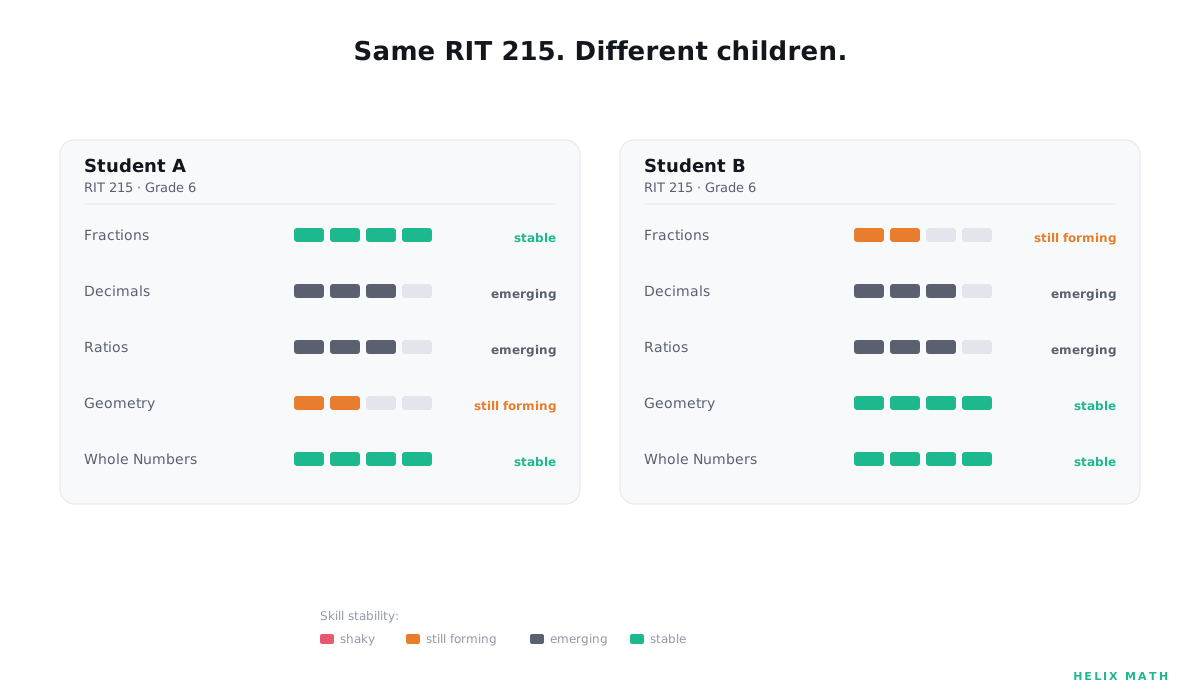
Two 6th graders can score the same 215 on MAP. One with secure fraction equivalence and geometry that is still developing. The other with fractions still developing and secure whole-number operations. The 215 does not distinguish them. The upcoming ratio unit will.
7th grade: proportional relationships and rational numbers
Proportional relationships are everywhere in 7th grade: constant of proportionality, unit rate as slope, graphing proportional relationships (the 7.RP cluster). Operations on rational numbers expand to include negatives and more complex fractions. Solving multi-step equations with rational coefficients (the 7.EE cluster) is core algebra-readiness work.
The 7th grader who cannot reliably cross-multiply is revealing a 5th-grade fraction-equivalence gap. The one who loses track when solving (2/3)x + 5 = 11 is revealing a 5th-grade fraction-operations gap. The one who cannot interpret a proportional graph is revealing a 6th-grade unit-rate gap, which traces back to 5th-grade fraction division.
The 7th-grade teacher sees a proportions problem. The underlying problem is still fractions. By this point teachers are no longer teaching fractions as their own unit — they are assuming students can use fraction understanding inside proportions, equations and rational-number work.
At this point the gap is three years old and has carried forward three times, and none of the prior years' grades flagged it.
8th grade and Algebra 1: where it gets hardest to work around
Rational expressions. Solving equations with fractional coefficients. Graphing linear equations in slope-intercept form (y = mx + b, where m is often a fraction). This is where the earlier gap becomes much harder to work around.
A student who reaches 8th grade without secure fraction operations cannot reliably solve (1/2)x - 3 = (1/4)x + 1 reliably. Cannot graph y = (2/3)x - 5 without a calculator and considerable time. The first Algebra 1 unit often becomes overwhelming, even when the 7th-grade report card looked clean.
NWEA's 2025 algebra-access study tracked 162,000 8th graders across 49 states and found stark mismatches between readiness and placement. Some students who met algebra-readiness benchmarks (based on MAP math scores and growth patterns) were never offered Algebra 1. Others were placed in Algebra 1 without meeting the benchmarks (Long, Kuhfeld, & Peters, 2025). The placement criteria varied wildly by district. The skill gaps did not. When a student whose fraction understanding is not yet secure enters Algebra 1, the course does not re-teach 5.NF.A.1. The first unit becomes a serious obstacle straight away.
The gap was there in 5th grade. The placement system did not catch it.
None of this is fixed in advance. The earlier the gap is found the easier it is to strengthen, and even older students can rebuild the prerequisite skills once the real issue is visible. The work is specific and bounded. What it takes first is seeing the underlying skill — not the stumble in 7th-grade ratios, and not the difficulty in 8th-grade algebra, but the earlier fraction skill underneath both.
Why grades and scores often do not show it
The gap hides because procedures can be memorized without understanding. A 5th grader can learn "flip and multiply" for division of fractions and score 80% on the unit test without knowing why it works. That works until the same idea appears in a new context: ratios in 6th, proportions in 7th, rational expressions in 8th.
This is how gaps form and why they stay hidden. The student looks fine on the worksheet and lost on the word problem. The student can carry out the procedure on its own but cannot apply it inside a word problem or a multi-step problem. The student is fluent but fragile: fast on trained problems, stuck on anything slightly different.
Grades reflect homework completion and test-day effort as much as mastery. A student who completes every assignment, studies hard, and follows the steps can earn a B+ in 5th-grade fractions without secure understanding. The report card says "proficient." The understanding underneath is not yet secure. The MAP score might be at or above grade-level mean. The percentile might be 55th or 60th. None of that tells you whether fraction equivalence is secure or simply memorized.
What parents need is not another score. It is the view underneath it: which specific skills are secure, which are still developing, and which need review. That is what Helix was built to show.
What you can do this week
The earlier you catch the gap, the easier the repair. Here is what to look for and what to do, by grade.
If your child is in 5th grade: Check fraction equivalence first. Can your child explain why 2/3 = 4/6 without reciting a rule? Can they place 3/4 and 5/8 on a number line without a calculator? Can they tell you which is larger, 5/8 or 3/5, and why? If the answer is no, or if they hesitate long enough that you suspect they are reconstructing a half-remembered algorithm, that is the skill to work on now. One focused week on equivalence can save a year of difficulty later. Focus on visual models (number lines, area models, fraction bars) alongside the procedures.
If your child is in 6th grade: Test ratio reasoning in context. "If 3 apples cost $2, how much do 9 apples cost?" If your child sets up the proportion correctly but cannot explain why it works, or if they set it up incorrectly and are guessing which numbers go where, the fraction foundation is not yet secure. Address fraction equivalence and division now, before 7th-grade proportions arrive. The 6th-grade curriculum will not loop back to fractions. The teacher will assume that foundation is already secure.
If your child is in 7th grade: Watch for rational-number operation errors. Does your child reliably add, subtract, multiply, and divide with negatives and fractions together? Can they solve (-1/2) + (3/4) fluently, without reconstructing the procedure step by step? Can they solve (2/3)x = 8 and explain why dividing both sides by 2/3 is the same as multiplying by 3/2? If not, the 5th-grade gap is still there. At this point the support needs to run on two tracks at once: keeping up with current 7th-grade proportions and equations, and targeted review of the earlier fraction skills underneath them.
If your child is in 8th grade or Algebra 1 and struggling: If your child is drowning in rational expressions, fractional coefficients, or slope problems, the answer is not simply "practice fractions." It is targeted review of the earlier fraction skills underneath, while keeping pace with current classwork. That means two things at once: help with current coursework and rebuilding prerequisite skills. It is harder and it takes longer, but those skills can still be rebuilt, and the earlier you start the more of the year you protect.
At any grade: If your child can execute the procedure but cannot explain the reasoning, assume the gap is there. If homework that went well yesterday is gone today, treat the skill as still developing. If performance swings widely between similar problems, the foundation is not yet secure. Address it now. Waiting does not help. The next grade's curriculum will not fix it.
It was never one big gap
The gap opened in 5th grade and by 8th it is hard to work around. But it was never one big gap. It was a sequence of small unfinished skills, with each year's content assuming the previous year's foundation was already secure.
The average hides the gaps. A composite score compresses the full skill profile into one number. A 215 in 6th grade can hide a 5th-grade fraction gap for another year. The 7th-grade teacher does not see the detail underneath the score. The Algebra 1 teacher does not know which earlier skills were never finished. Each year assumes the foundation was built, and when it was not, the student is the one who runs into it.
The earlier you find the gap, the easier it is to strengthen. The later you find it, the more prerequisite skills need rebuilding. The good news is that even in 8th grade they can be rebuilt. It just takes longer. That is what Helix Math was built to do. The Helix Program begins with a 30 to 40 minute diagnostic that maps the skills underneath your child's math score: which are secure, which are still developing, and which need review. It then turns that map into a targeted practice path, starting with the skills that matter most. For a quick first look at whether those fraction skills are secure, the free grade 5 MAP math practice problems take a few minutes and need no login.
The gap does not close on its own. But once you can see which skill it is, you know where to start.
MAP® and RIT® are registered trademarks of NWEA. Helix Math is not affiliated with or endorsed by NWEA.