What a 210 MAP math score means (by grade and season)
Your fifth grader came home with a 210 on the fall MAP® math test, and the teacher said it looked broadly on track. You exhaled.
Then you remembered the old report from fourth-grade fall. Same number, 210. Back then it felt strong. This year it sits closer to the middle of the pack. The score did not become wrong. The question changed. A 210 MAP math score is easier to read once you know the grade, the season, and whether the number is still moving.
The short answer
- A 210 is a transition score in a practical sense, not an official NWEA category: the same number sits in very different places by grade and season. On the approximate 2025 norms it reads as strong in 4th grade (about the 80th percentile in fall), closer to the middle by 5th (about the 37th by spring), and below the middle by 6th (about the 29th by spring).
- When the number stays the same, your child's standing still shifts, because the comparison group's typical score rises across the year.
- Around a 210, the skills worth checking are usually not basic arithmetic. They are fraction equivalence, decimal comparison, multi-step reasoning, and early proportional thinking.
- A 210 on its own does not settle which of those prerequisite skills are stable and which still need a closer look. That question lives one layer underneath the score.
What this score means by grade
A MAP math RIT of 210 sits at about the 50th percentile for grade 6 in fall, inside the typical range for that grade (199 to 221). The same number means something different at every grade and season, which is what the table below shows.
| Grade | Fall | Winter | Spring |
|---|---|---|---|
| Grade 2 | 99th | 97th | 92nd |
| Grade 3 | 95th | 86th | 74th |
| Grade 4 | 79th | 64th | 50th |
| Grade 5 | 60th | 45th | 37th |
| Grade 6 | 50th | 36th | 29th |
| Grade 7 | 34th | 27th | 23rd |
| Grade 8 | 25th | 20th | 17th |
A 210 sits at or above the 99th percentile for Grade 1 and below, so those grades are left out of the table above.
Percentiles are calculated from NWEA 2025 MAP Growth math norms (publicly published Quick Reference). A percentile says where a score sits against same-grade peers. It does not say which specific skills are secure and which need review; only a skill-level check can do that.
What a 210 RIT® actually is (and why the grade matters more than the number)
A 210 is a single point on the RIT scale, which is equal-interval: 150 to 151 is the same distance as 210 to 211. That makes it good at tracking growth, but it leaves a bare number hard to read without two more facts: the grade your child is in and the season they tested.
Here is the same 210 across the grades where it clusters most, on the approximate 2025 NWEA norms. These are rounded; exact percentiles depend on how close the test date fell to NWEA's fall, winter, and spring windows (NWEA 2025 norms):
| Grade | Fall %ile | Winter %ile | Spring %ile |
|---|---|---|---|
| 4 | 80 | 64 | 50 |
| 5 | 60 | 45 | 37 |
| 6 | 50 | 36 | 29 |
Read across one row and the score holds steady while the percentile slides. A 210 in 4th-grade fall is about the 80th percentile, genuinely strong; by 6th-grade spring the same number is near the 29th. The child did not get worse; the reference group grew faster than the number did. For the full picture, see MAP math scores by grade, including typical 6th grade scores.
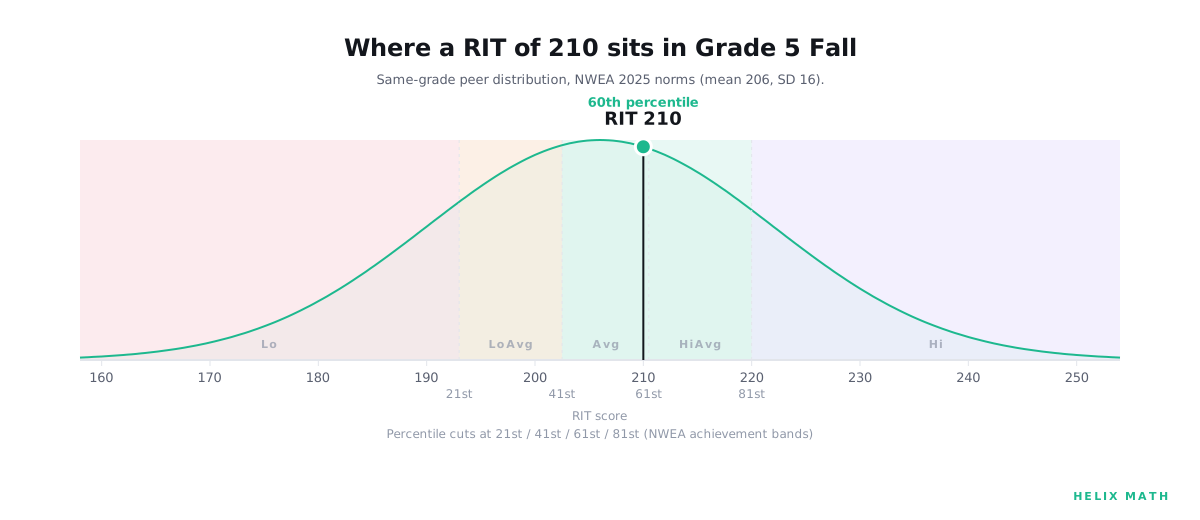
The overall RIT score gives you the 210. The fuller MAP reports may add instructional-area context, and the overall number on its own still does not settle which prerequisite skills are stable and which need a closer look.
Why 210 is the transition number (4th comfortable, 5th on-grade, 6th worth a closer look)
A 210 sits at the hinge where elementary fluency meets middle-school reasoning, which is why its meaning shifts so quickly.
In 4th grade, especially in fall, a 210 is an ahead-of-pace score. It suggests the basics are probably not the main concern, though fractions are still worth watching as they begin carrying more weight across the year.
In 5th grade, a 210 means keeping pace without pulling ahead. This is the year fraction equivalence and decimals do the heavy lifting (5.NF, 5.NBT.A.3), so those are the skills most worth checking at this score.
In 6th grade, a 210 is closer to a support signal than a reassurance signal. A single 210 does not prove a stall, but if your child was near this same number a year earlier, the flat trajectory matters as much as the percentile, especially since typical fall-to-spring growth in these grades runs about 10 to 13 RIT points (NWEA growth norms). The skills most worth checking are ratio and proportional reasoning, the ground pre-algebra is built on (6.RP.A.3).
What to examine alongside a 210
Around this score band, the skills worth checking are usually not basic counting or single-step arithmetic. The more useful questions cluster in a few predictable places: fraction equivalence when denominators are not simple multiples (4.NF.A.1), comparing fractions and decimals (4.NF.A.2), multi-step word problems, and the first steps of ratio reasoning. These are the skills 6th-grade math leans on early.
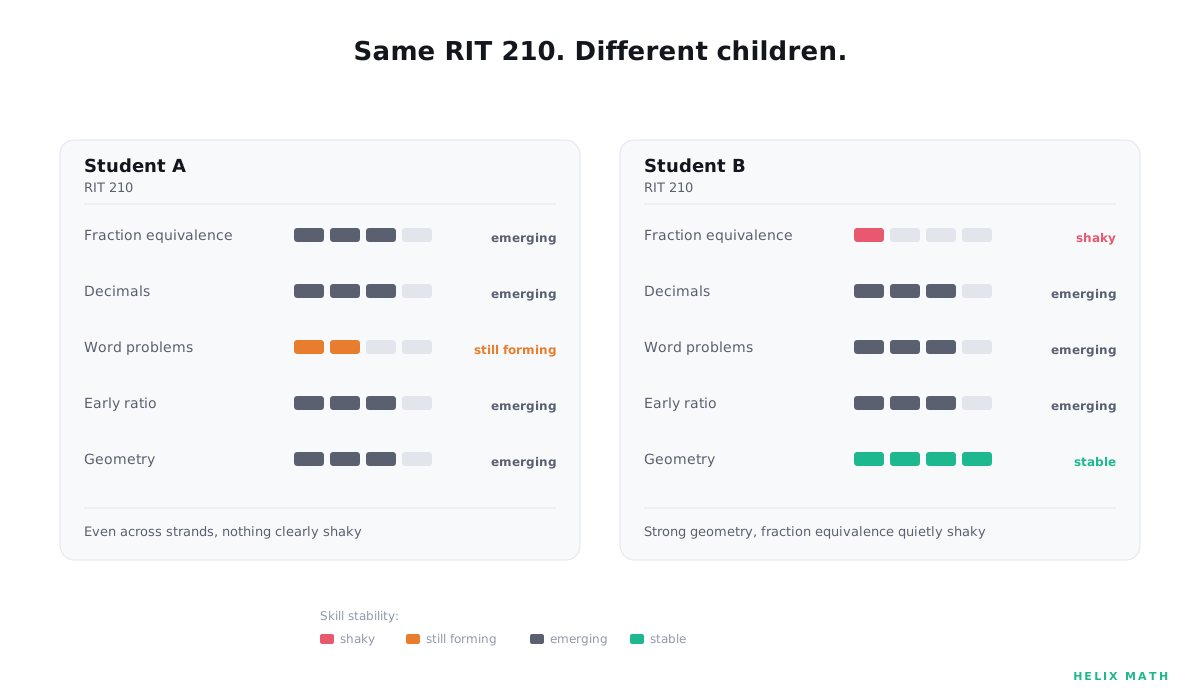
Here is the part the overall score does not settle. Two students can arrive at the same 210 through different paths.
One may be even across strands: not far ahead, nothing clearly shaky, just broadly steady. Another may be strong in geometry and whole-number operations while fraction equivalence is quietly shaky. A third may handle decimals but freeze when a word problem asks for the same idea in a different form.
The same overall score can describe different learning profiles. That does not make the score wrong. It means the next question has to be more specific.
What you can do this week
A 210 is not a verdict, and what you do with it depends on your child's grade. For each check below, listen less for speed and more for whether your child can explain their thinking; the reasoning matters more than the answer.
1. If your child is in 4th grade, watch fractions now. This is the moment to catch equivalence gaps before they harden. Ask one low-key question, framed as curiosity rather than a test: Which is bigger, 3/4 or 5/8? A clear method is a good sign. A guess is 4.NF.A.2 waving a flag a year early.
2. If your child is in 5th grade, look for instructional-area detail, not just the overall number. If your school shares goal-area or instructional-area scores from the MAP report, read those first: a 210 overall can sit on very different strand patterns underneath. Two quick checks at home: Which is bigger, 0.5 or 0.45? and Write 3/5 as a decimal.
3. If your child is in 6th grade, treat a 210 as a signal to look closer, especially if the number is near where it was a year ago. Early ratio and proportional reasoning is the skill most often worth a check. Try: A recipe uses 2 cups of flour for every 3 cups of sugar. How much flour goes with 9 cups of sugar? A freeze here points to the kind of gap pre-algebra leans on early.
The question a 210 leaves open is which specific prerequisite skills appear stable and which still need more evidence. That is a more granular question than an overall achievement score is designed to answer.
A correct answer is helpful evidence, but it is not the whole story. A skill is steadier when a child can explain it, represent it, and use it when the problem changes.
That is what Helix Math was built for. A 210 lands in different places depending on the grade, so the smallest useful step is a check pitched at your own child's year: the free MAP math practice problems by grade are fourteen questions, about fifteen minutes, and no sign-up. The Helix Program begins with a 30 to 40 minute diagnostic that returns a skill-level map of which prerequisite skills appear secure, which are still developing, and where a few focused weeks of practice may help before a gap quietly compounds into the next grade.
The number did not change them
A 210 is one test sitting, a single number read against a peer benchmark that keeps moving. In 4th grade it can look like a head start; by 6th grade the same number is a reason to look closer. Neither reading is a verdict on your child.
For many students in this band, fractions are the fault line: equivalence in 4th grade, fraction-decimal connections in 5th, and proportional reasoning in 6th.
A 210 tells you where your child is performing relative to peers. The work underneath is finding out which parts of the math are ready to carry more weight.
MAP® and RIT® are registered trademarks of NWEA. Helix Math is not affiliated with or endorsed by NWEA.