Is 225 a Good MAP Math Score? Percentiles by Grade and Season
Your sixth grader came home with a 225 on the fall MAP® math test. The percentile says 83rd. The teacher said "above average." You nodded, relieved. But last week, your child couldn't explain why you flip the second fraction when dividing. And this week's homework on ratios fell apart. The score may be accurate. It simply does not answer the question you now have. To see where a 225 lands at every grade and season, see MAP math scores by grade, including typical 6th grade scores.
The short answer
- A 225 in 6th-grade math sits at the 83rd percentile in fall, 70th in winter, 61st in spring, "above average" by rank, but percentiles drop as peers catch up across the year.
- The same 225 means something very different in 4th grade (96th percentile fall, strong trajectory) vs. 8th grade (57th percentile fall, below typical algebra-readiness expectations).
- Mid-range scores like 225 are one of the most common places for procedural fluency without conceptual depth to hide. The student executes steps correctly but cannot explain why they work or transfer to novel contexts.
- Read on for what 225 actually corresponds to skill-wise, how to probe whether your child's understanding is stable, and why normative growth from this position may not be enough.
What this score means by grade
A MAP math RIT of 225 sits at about the 57th percentile for grade 8 in fall, inside the typical range for that grade (210 to 234). The same number means something different at every grade and season, which is what the table below shows.
| Grade | Fall | Winter | Spring |
|---|---|---|---|
| Grade 3 | 99th | 98th | 94th |
| Grade 4 | 96th | 89th | 80th |
| Grade 5 | 88th | 78th | 69th |
| Grade 6 | 83rd | 70th | 61st |
| Grade 7 | 68th | 59th | 52nd |
| Grade 8 | 57th | 48th | 42nd |
A 225 sits at or above the 99th percentile for Grade 2 and below, so those grades are left out of the table above.
Percentiles are calculated from NWEA 2025 MAP Growth math norms (publicly published Quick Reference). A percentile says where a score sits against same-grade peers. It does not say which specific skills are secure and which need review; only a skill-level check can do that.
What percentile is a 225 MAP math score?
A 225 in 6th-grade math sits at the 83rd percentile in fall, drops to the 70th percentile in winter, and settles near the 61st percentile by spring (NWEA 2025 MAP Growth Norms). The score itself did not change. The reference population did. As more students complete the fall-to-spring instructional window, the distribution tightens, and the same RIT® corresponds to a lower percentile rank.
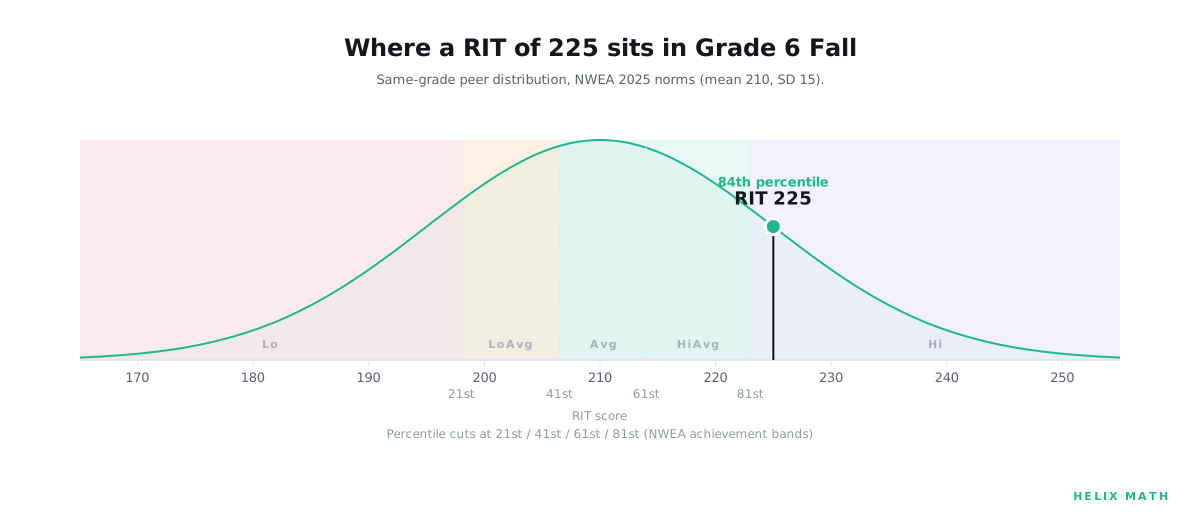
The same 225 tells a very different story depending on grade:
| Grade | Fall percentile | Winter percentile | Spring percentile |
|---|---|---|---|
| 4 | 96th | 89th | 80th |
| 5 | 88th | 78th | 69th |
| 6 | 83rd | 70th | 61st |
| 7 | 68th | 59th | 52nd |
| 8 | 57th | 48th | 42nd |
A fourth grader scoring 225 in fall sits at the 96th percentile, strong trajectory, well ahead of the grade-level mean. An eighth grader at 225 sits at the 57th percentile in fall, below where 8th-grade algebra coursework typically assumes students to be. The number is the same. The developmental position is not.
Percentiles shift because the comparison group changes, not because your child's skill changed. This is a property of norm-referenced measurement, not a judgment of your child's progress.
What a 225 means in 6th grade: the "safe middle" trap
A 225 in 6th-grade math looks like steady progress. It sits above the grade-level mean (210 in fall, 216 in winter). The percentile band, 70th to 83rd depending on the season, reads as comfortably above average. Parents see this and relax. Teachers see this and move on. The score does not trigger concern.
But this is a score band where procedural fluency without conceptual depth hides especially easily. The National Council of Teachers of Mathematics states that procedural fluency requires efficiency, flexibility, and accuracy built from conceptual understanding. A student who can execute fraction operations but cannot explain why you invert and multiply when dividing fractions is fluent but fragile (NCTM Position Statement: Procedural Fluency in Mathematics).
A sixth grader at 225 typically demonstrates competence in whole-number operations and can execute multi-step fraction algorithms. They may score well on computational items: simplify 3/4 ÷ 1/2, solve for x in 2x + 5 = 13, convert between fractions and decimals. What the score does not tell you is whether the student can explain the reasoning, generate their own example of a concept, or transfer the procedure to a novel context. That distinction is the subject of what MAP scores don't tell you.
Here is the trap. The homework comes home correct. The quiz grades are B's and A's. The MAP percentile sits in the 70s. Meanwhile, the student is applying memorized steps to familiar problem types. When 7th grade introduces proportional reasoning (CCSS 7.RP.A.2), unit-rate problems embedded in complex scenarios, and the expectation that students justify their approach, the fluent but fragile foundation begins to show cracks.
MAP measures where a student is performing. The stability of that performance, whether it's built on concepts or memorized steps, lives at a different resolution.
Two students, same 225, completely different foundations
Two sixth graders take the fall MAP math test. Both score 225. Both sit at the 83rd percentile. The teacher sees identical numbers on the roster. The underlying skill profiles could not be more different.
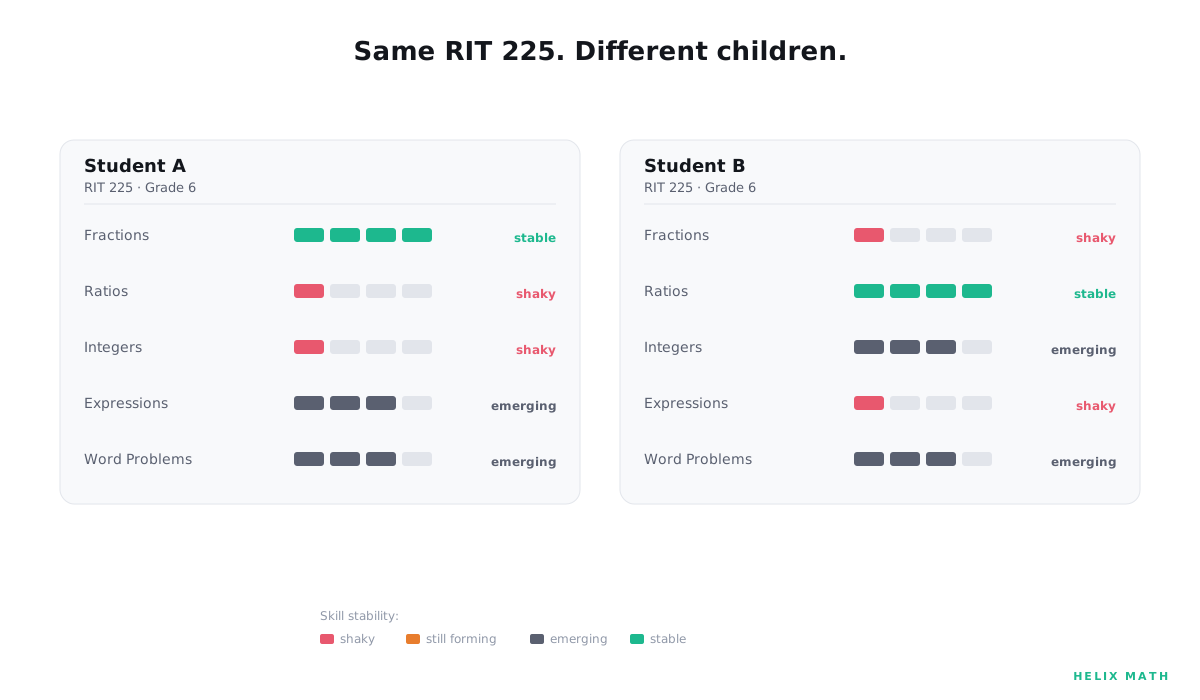
Student A (225, 6th grade fall) demonstrates strong procedural fluency in whole-number operations and fraction computation. She executes algorithms correctly: adds, subtracts, multiplies, and divides fractions without hesitation. Her quizzes on order of operations and multi-step equations come back with high marks. What sits underneath the 225: shaky ratio reasoning, uncertain proportional thinking, and shaky negative-number sense. When asked to explain why 3/4 ÷ 1/2 equals 3/2, she says "you flip it and multiply" but cannot draw a model. When the ratio problem changes from "3 apples cost $2" to "If 5 pencils cost $3, how much do 8 pencils cost?" she hesitates, tries to set up a proportion, and abandons it halfway.
Student B (225, 6th grade fall) demonstrates strong conceptual understanding of ratios and proportional relationships. He can explain why equivalent ratios form a straight line through the origin. He generates his own unit-rate examples and transfers ratio reasoning across contexts. What sits underneath his 225: shaky fraction equivalence, uncertain decimal-fraction conversion, and shaky algebraic-expression simplification. When asked to simplify 2/3 + 1/4, he reaches for a calculator. When the problem asks him to write an expression for "three more than twice a number," he stares at it for two minutes and guesses.
Both students score the same 225. Similar patterns show up at 221. The skill-level picture (which prior-grade foundations are shaky, which are stable) lives at a resolution MAP was not designed to measure.
For the first student, 7th-grade pre-algebra will lean hard on flexible ratio reasoning. For the second, 8th grade makes algebraic manipulation the dominant mode. Both gaps are already there in the skill profile today. Neither is visible in the score.
What you can do this week
Five concrete checks you can run at home. These are not quizzes. They are probes. The goal is to find out whether your child's correct answers rest on memorized procedures or transferable understanding.
1. Ask your child to explain why a procedure works, not just execute it. Give the problem 3/4 ÷ 1/2. Ask for the answer (should get 3/2 or 1.5). Then ask: "Draw me a picture of what's happening when you divide three-fourths by one-half." If they can execute the algorithm but cannot visualize or explain it, the procedure is fluent but the concept is fragile.
2. Give a slightly modified version of a problem they just solved. If your child correctly solves "If 3 apples cost $2, how much do 5 apples cost?" then ask: "If 7 shirts cost $35, how much do 4 shirts cost?" The numbers changed. The structure did not. Does the method transfer, or does your child start over from scratch each time?
3. Check whether they can generate their own example of a concept. Say: "Make up a ratio problem where the answer is 3:5." Or: "Give me an example of two fractions that are equivalent to 1/2." A student who understands ratios can generate examples. A student who has memorized a procedure for solving ratio problems cannot reverse-engineer the concept.
4. Probe negative-number intuition. Ask: "Is negative 5 closer to zero or to negative 10? Why?" Then ask: "Which is bigger, negative 3 or negative 7?" A sixth grader preparing for pre-algebra should have a mental model of the number line that includes negatives. If your child hesitates or says "negative 7 because 7 is bigger," the integer reasoning is still forming.
5. Test word-problem reasoning without numbers first. Give the word problem: "Maria ran twice as far as Jamal. Together they ran 15 miles. How far did Maria run?" Before your child writes anything, ask: "What operation would you use, and why?" If they can name the reasoning (set up an equation, let Jamal's distance be x, Maria's is 2x, so x + 2x = 15) they are thinking algebraically. If they guess "division? or maybe times?" they are pattern-matching, not reasoning.
If your child struggles with two or more of these checks, the 225 is masking shaky foundations.
When "average growth" isn't enough
NWEA research distinguishes necessary growth from normal growth (NWEA Blog: Normal vs. Necessary Academic Growth). Normal growth is what the typical student in the norming sample achieved. A student at the 43rd percentile who grows at the 50th-percentile rate stays at the 43rd percentile. The rank does not change. The peer distribution moved; the student moved with it.
A sixth grader at 225 in fall (83rd percentile) who grows 10 RIT points, the typical fall-to-spring gain for 6th grade (NWEA 2025 MAP Growth Norms), reaches 235 by spring. That student now sits at roughly the 70th percentile in spring. The rank dropped slightly, but the growth was normal. The student kept pace with peers.
Here is the problem. Normal growth does not close conceptual gaps. It carries them forward. If your sixth grader at 225 has shaky ratio reasoning and unstable negative-number sense, ten points of generic practice will not resolve those specific gaps. The student will enter 7th grade at 235 (68th percentile fall), still carrying the same fragility, now layered underneath more advanced content.
Pre-algebra readiness does not require percentile maintenance. It requires stable foundations in proportional reasoning (CCSS 7.RP.A), the rational number system (CCSS 6.NS.C), and algebraic thinking (CCSS 6.EE.A). If those foundations are shaky at 225, the necessary growth is more than the typical 10 points, and it has to be targeted at the specific prior-grade skills that 7th-grade content depends on, not spread across generic practice.
Normative growth tracks the peer distribution. Necessary growth tracks the skill prerequisites your child will need next year. Those are different ladders.
That is what Helix Math was built to do. If you want a smaller first step, the free grade 6 MAP math practice problems are fourteen questions in about fifteen minutes, with feedback by topic and no sign-up. The Helix Program begins with a 30 to 40 minute diagnostic that returns a skill-level map of which skills sit secure, which are still developing, and which need attention before pre-algebra assumes they are there. When you are ready to see the layer underneath the 225, the diagnostic is the next step.
The 225 told you where your child is performing. The work ahead is finding out whether that performance will hold.
MAP® and RIT® are registered trademarks of NWEA. Helix Math is not affiliated with or endorsed by NWEA.