What a 230 MAP math score means (and what sits underneath it)
Your seventh-grader came home with a 230 on the spring MAP® math test. The teacher wrote "above average" on the report. Your child got into the advanced math section. You exhaled. But last week, a homework problem about mixing paint colors took forty minutes and ended in tears. You Googled "230 MAP math score" at 10pm because the number felt good but the homework didn't match. To see where a 230 lands at every grade and season, start with MAP math scores by grade, including typical 7th grade scores.
The short answer
- A 230 MAP math score is legitimately strong. It sits at the 71st percentile for 6th graders in spring, 52nd percentile for 8th graders, and well above typical for younger students.
- The percentile shift matters: 230 means something very different in 4th grade (87th percentile) than in 8th grade (52nd percentile).
- A 230 sits at the threshold where the adaptive test moves into early algebra (equations, expressions) without fully confirming mastery of ratio, proportion, unit rates, and scale factor. Those are the 6th and 7th grade skills that make or break pre-algebra.
- Read on for what a 230 hides, which skills to check, and how to tell whether the foundation under the number is secure or still needs review.
What this score means by grade
A MAP math RIT of 230 sits at about the 67th percentile for grade 8 in fall, inside the typical range for that grade (210 to 234). The same number means something different at every grade and season, which is what the table below shows.
| Grade | Fall | Winter | Spring |
|---|---|---|---|
| Grade 3 | 99th | 99th | 97th |
| Grade 4 | 98th | 94th | 87th |
| Grade 5 | 93rd | 86th | 78th |
| Grade 6 | 89th | 79th | 71st |
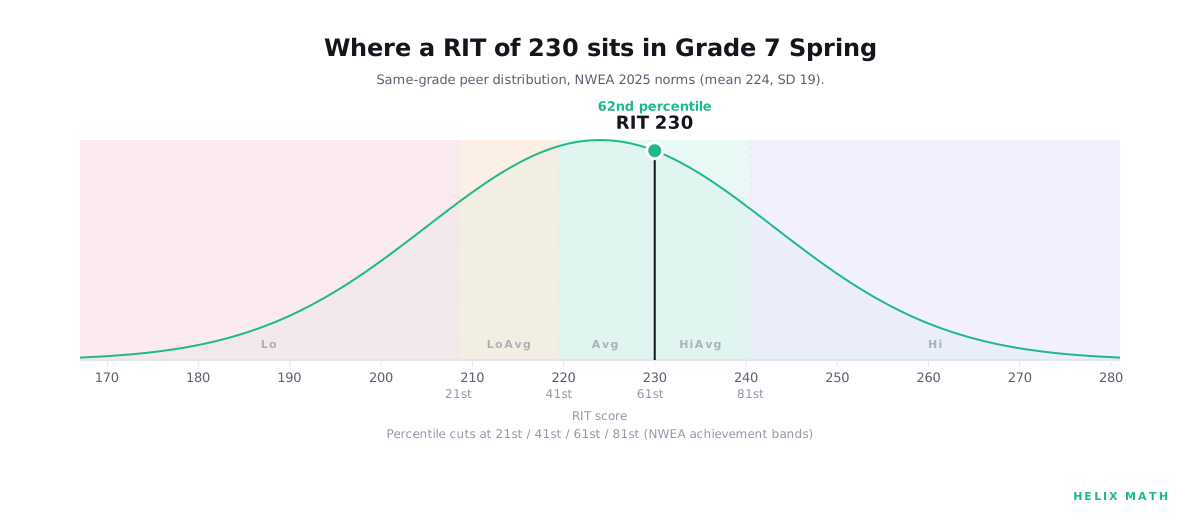
| Grade 7 | 78th | 69th | 62nd |
| Grade 8 | 67th | 58th | 52nd |
A 230 sits at or above the 99th percentile for Grade 2 and below, so those grades are left out of the table above.
Percentiles are calculated from NWEA 2025 MAP Growth math norms (publicly published Quick Reference). A percentile says where a score sits against same-grade peers. It does not say which specific skills are secure and which need review; only a skill-level check can do that.
What a 230 MAP math score means (by grade)
A 230 is a fixed point on the RIT® scale. The scale is equal-interval, so the distance between 150 and 151 is the same as the distance between 230 and 231. But what a 230 means in percentile terms changes dramatically with grade.
In 6th grade spring, a 230 is the 71st percentile. Solidly above average. In 8th grade spring, that same 230 is the 52nd percentile. Just above the middle, still fine, not remarkable. In 4th grade spring, a 230 is the 87th percentile, the top quintile and exceptional for that age (NWEA 2025 Norms Quick Reference).
The number didn't change. The reference group changed. A 230 reflects roughly the same skill level on the general math construct at any age. But a 4th grader at that level is far ahead of expectations. An 8th grader at that level is on track.
Here's the full percentile picture for a 230 across middle school:
| Grade | Fall %ile | Winter %ile | Spring %ile |
|---|---|---|---|
| 6 | 89 | 79 | 71 |
| 7 | 78 | 69 | 62 |
| 8 | 67 | 58 | 52 |
The teacher who wrote "above average" on your 7th grader's spring report was not wrong. A 230 in 7th grade spring is the 62nd percentile. But if you were imagining "above average" meant 75th or 80th percentile, the gap between expectation and reality is what brought you here.
One note on the numbers above. NWEA updated its norms in 2025, and post-pandemic declines mean the same RIT now sits at a slightly higher percentile than it did under the 2020 norms. The student didn't get better. The reference population shifted (NWEA: What's new in the 2025 MAP Growth norms).
The percentile tells you standing. It does not tell you readiness. That requires looking one layer deeper, the subject of what MAP scores don't tell you.
What skills a 230 represents (and what it might not)
NWEA publishes RIT reference charts that map score bands to skill categories. The 221–230 band covers late-elementary operations: multi-digit multiplication and division, fraction operations, basic geometry, and introductory ratio work. The 231–240 band is where algebraic thinking begins in earnest: simplifying expressions, solving equations, working with exponents (NWEA RIT Reference Charts, 2019).
A 230 sits at the cusp. The adaptive algorithm has noticed your child can handle some of the 221–230 items correctly and has started sampling from the 231–240 pool. That's why a 230-scoring 7th grader might see one-step equations or problems involving negative numbers on the test.
But here's the structural issue: the adaptive test prioritizes breadth over depth. It samples across five or six instructional areas (Operations and Algebraic Thinking, The Real and Complex Number System, Geometry, Measurement and Data, Statistics and Probability) to estimate an overall RIT. It does not drill down on any single area long enough to confirm the skill is deeply secure.
Your child's MAP Family Report includes goal-area scores for each of those strands. A student can score 230 overall while sitting at "LoAvg" (21st–40th percentile) or even "Lo" (below 21st percentile) in a critical strand like The Real and Complex Number System, which includes ratio, proportion, and rational number fluency (NWEA MAP Growth Instructional Areas).
The MAP report tells you a 230. The skill-level picture (whether the skill that needs review is in unit rates, scale factor, or percent applications) lives at a different resolution than MAP measures.
MAP Growth was built to measure general achievement and growth, not to audit mastery skill by skill. Parents reading a 230 as "ready for algebra" are making a leap the test does not support.
Why ratio and proportion gaps hide at high scores
Ratio and proportion are the silent killers of pre-algebra readiness. Even university physics students who can graph lines and solve equations still stumble on setting up a proportion or interpreting a unit rate in an unfamiliar context (Physics education research on ratio reasoning, arXiv:1511.08960).
The Common Core places ratio and proportion squarely in 6th and 7th grade: 6.RP.A.3 (unit rates), 7.RP.A.2 (proportional relationships), 7.RP.A.3 (multi-step ratio and percent problems). These are new conceptual ground, not review. A student can enter 6th grade fluent in fraction operations and still find proportional reasoning a real obstacle.
MAP Growth tests ratio items, but because the test samples broadly, a student can answer enough of them correctly to push RIT into the 220s or 230s without demonstrating fluent, flexible proportional reasoning. The RIT only certifies that the student can answer items at that difficulty about half the time. It does not check whether they can apply ratio reasoning in word problems, scale drawings, or percent-change contexts.
A 7th grader with a 230 might set up a ratio table on a scaffolded problem and freeze when the same ratio is embedded in a three-sentence word problem about speed, distance, and time. The adaptive algorithm doesn't catch that gap. It samples across strands to estimate skill, then moves on. It does not measure whether a student can fluently set up a proportion or interpret a rate in context.
That is why a 230-scoring 7th grader can test into pre-algebra and still struggle three weeks in, when the course assumes proportional reasoning is automatic.
What you can do this week
If your child scored 230 and homework is going smoothly, do not invent a problem. But if the homework tears are real and the teacher's "above average" doesn't match what you see at the kitchen table, trust what you see.
Here are three concrete actions:
1. Check the goal-area scores on the MAP Family Report. Look for the strand labeled "The Real and Complex Number System" or "Operations and Algebraic Thinking." If that strand shows "Lo" (below 21st percentile) or "LoAvg" (21st–40th percentile), you've found the area to look at. A 230 overall with a Lo in the number-systems area means the student is strong in geometry or statistics but needs review in the ratio-and-proportion layer that pre-algebra depends on.
2. Give your child three diagnostic questions. Do not make it a test. Frame it as "I want to see how you think through these." Try these:
- "A car travels 180 miles in 3 hours. What is the unit rate in miles per hour?"
- "On a map, 1 inch equals 15 miles. If two cities are 4.5 inches apart on the map, how far apart are they in real life?"
- "A jacket costs $80. It is on sale for 25% off. What is the sale price?"
If your child can do two of three fluently (correct answer, clear method, no calculator struggle), the foundation is secure. If they freeze, guess, or need multiple re-explanations, the gap is real. That's 6.RP.A.3, 7.RP.A.2, and 7.RP.A.3 in action.
3. Do not flood them with random practice. Assigning 50 mixed problems from a workbook will not target the area that needs review. It will burn time and build frustration. Math gaps carry forward when ratio skills stay unfinished. A gap in 6th-grade unit rates becomes a 7th-grade proportional-relationships gap becomes an 8th-grade slope gap. The earlier you isolate the missing piece, the less you have to rebuild later.
Most practice tools measure whether the answer is correct. They do not measure whether the underlying ratio-reasoning skill is secure.
That is what Helix Math was built to do. The free grade 7 MAP math practice problems are the quickest version of that look: fourteen questions across proportions, integers, equations and probability, in about fifteen minutes and with no sign-up. The Helix Program begins with a 30 to 40 minute diagnostic that maps which specific ratio and proportion skills your seventh-grader has secured and which still need review. It doesn't generate a new RIT. It shows you the skill-level picture the MAP report cannot.
The number is good (now make sure the foundation is secure)
A 230 is a strong score, not a problem score. If your child is thriving in their math class and homework feels manageable, the 230 is doing its job.
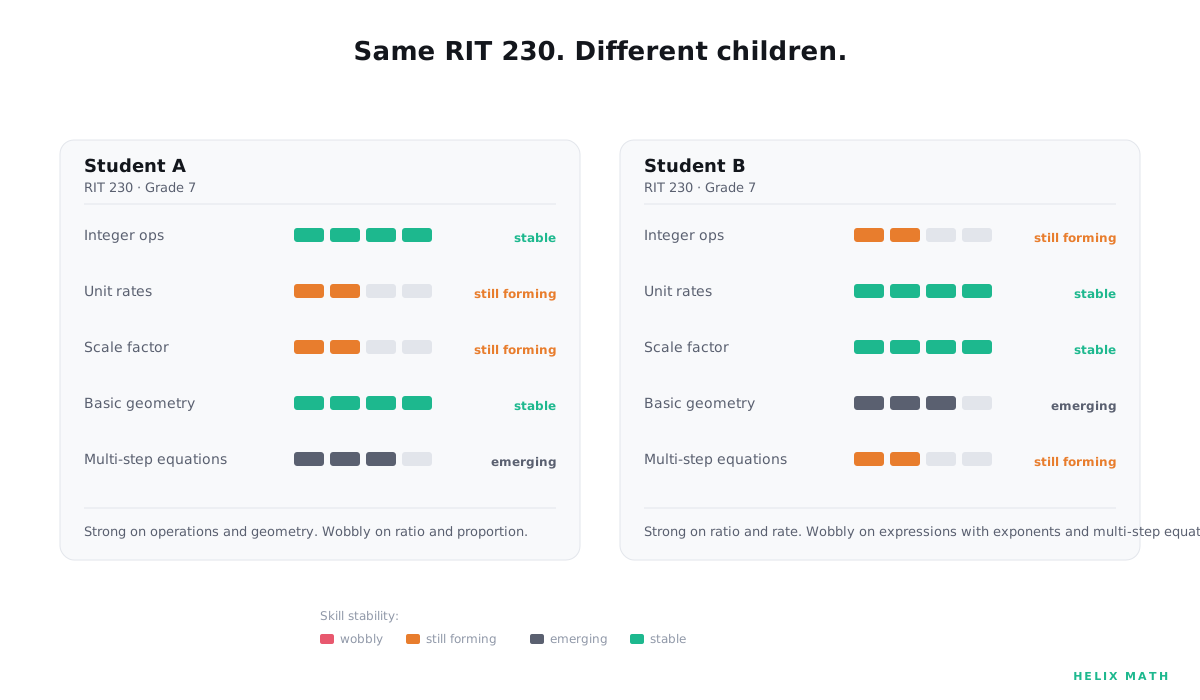
But the MAP number alone was not designed to resolve whether the skills under the surface are secure. Two students can score the same 230 for completely different reasons. One might be strong in operations and geometry but need review in ratio and proportion. The other might be fluent with rates and scale but still be developing their grasp of expressions with exponents. Both get a 230. Both hear "above average." They need different work.
The goal is not a higher RIT. The goal is to confirm the ratio-and-proportion layer is solid before pre-algebra begins. If it's not, six weeks of targeted work now prevents six months of struggle later.
A 230 is a strong score. What matters now is whether the skills underneath it are strong too.
MAP® and RIT® are registered trademarks of NWEA. Helix Math is not affiliated with or endorsed by NWEA.