False mastery in math: right answer, wrong reasoning
Your 6th grader just finished 20 fraction-multiplication problems in 12 minutes. All correct. You check the answers, mark them with a satisfying row of checkmarks, and feel relieved. Fractions are settled. Two days later, the quiz comes home. The first problem: "A recipe calls for ⅔ cup of flour. You want to make 1½ batches. How much flour do you need?" She left it blank. You ask her about it that night. She says, "I didn't know what to do." The worksheet said she knew. The quiz said she did not.
The short answer
- False mastery is when a student produces correct answers using reasoning that will not survive transfer, novel framing, or removal of scaffolding. The right answer for the wrong reason.
- It is one of the most common ways gaps stay hidden in students who score well, and it explains why a child can ace worksheets and fail tests on the same skill.
- A MAP® score was not designed to resolve the difference between real mastery and false mastery. Two students with identical RIT® can have completely different reasoning stability underneath.
- Read on for what false mastery looks like in three real classroom moments, why it compounds, and how to surface it.
What false mastery actually is
Three mechanisms account for most cases. First: the memorized procedure without conceptual anchor. The student has learned "flip and multiply" for fraction division and can execute it perfectly on a worksheet, but cannot explain why it works or recognize when the operation is needed in a word problem. Second: help that quietly carries them. The student solves a multi-step equation at the kitchen table with parent prompts, appears to understand, then blanks on the same problem type on the quiz.
The hint was the skill. When the hint left, so did the performance.
Third: pattern-matching that breaks under transfer. The student sees "find the area" and multiplies length by width every time, correctly, until the problem asks for the area of a triangle and the formula changes. The pattern-matched move fails because the reasoning was never there.
False mastery is not lying. It is not careless work. The student usually does not know their reasoning is brittle. It looks like mastery in the moment, to both the student and the parent, until something shifts and the skill collapses. Real mastery is stability over time, across contexts, without prompts. False mastery is borrowed, brittle, or pattern-matched.
Three moments false mastery shows up
Worksheet-to-word-problem drop. Your 5th grader rips through 20 fraction-multiplication problems. All correct, all fast. 5.NF.B.4 appears settled. Then the first word problem: "A baker uses ⅔ cup of sugar per batch of cookies. She makes 4½ batches. How much sugar does she use?" The child stares at it. Asks what to do. The worksheet rewarded the memorized procedure. The word problem required the reasoning. Most students score well on the first and blank on the second.
Parent-helped homework. Your 7th grader sits at the kitchen table solving equations. You give a hint: "What's the opposite of adding 5?" They write "subtract 5" and solve the equation correctly. You feel good. They seem to understand. Two days later, the quiz comes home: three equation problems, all blank. You ask what happened. They say, "I didn't know where to start." The skill was real when the hint was there. The hint was the skill. Help like that collapses when the scaffolding is removed.
Memorized-procedure-breaks-on-variation. Your 6th grader has mastered "flip and multiply" for fraction division. Practice sheet: 10/10 correct. Then the quiz asks: "How many ½-cup servings are in 3 cups?" They write "3 ÷ ½" and stop. They do not flip. They do not know whether to flip. The memorized move only works when the problem looks like the worksheet. The reasoning was never there, so the transfer fails.
These are not edge cases. They are common in students who look "fine" on paper but struggle when the format changes.
Why false mastery lives below MAP's resolution
MAP Growth is a placement and growth instrument. It estimates where a student sits on the vertical achievement scale. It does not test depth of reasoning. MAP samples breadth. It asks 40 to 50 items drawn from the full K-12 continuum, adjusts difficulty in real time, and lands on a RIT score. That RIT tells you roughly where the student is. It does not tell you how they got there.
Two students can both score 221 in 6th-grade math. One has even, shallow coverage across all four strands: geometry, operations, algebraic thinking, and measurement. The other has deep, stable mastery on geometry and measurement, and false mastery on fractions and ratios. They memorized the procedures. They can execute them on isolated drill. But the reasoning will not survive transfer. MAP returns the same number for both students. The skill-level picture sits below the score's resolution.
This is not a flaw in MAP. MAP was built for broad academic measurement and growth tracking, not reasoning resolution. It does exactly what it was designed to do. But that design means it was not built to resolve the difference between a student who understands fractions and a student who has memorized "flip and multiply." MAP tells you a 221. The skill-level picture (whether the child got there by understanding fractions or by memorizing "flip and multiply") lives at a different resolution.
What false mastery looks like when you surface it
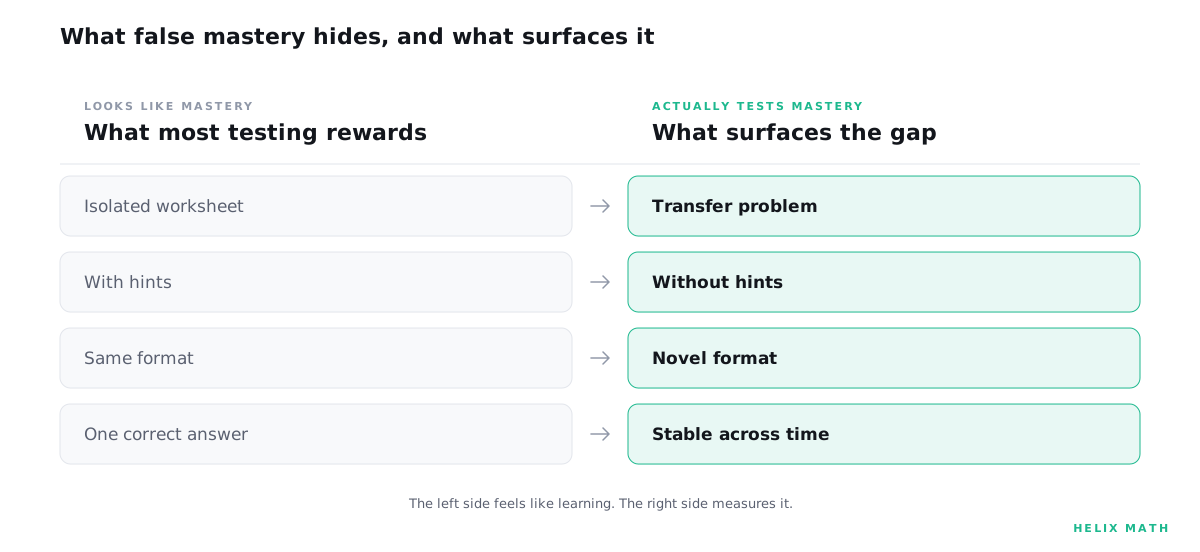
To find false mastery, you have to test for stability, not just accuracy. That means repeated performance across days, not single-moment correctness. It means varied problem types and minimal hints, so the reasoning is the thing being measured, not the scaffolding.
The Helix diagnostic is built around that principle. It uses rolling-window gates: a skill is marked stable only after the student demonstrates 4 correct answers out of the last 5 attempts, plus 3 consecutive correct answers. If the student gets two right, then one wrong, then two right again, the skill stays shaky. Accuracy is high. Stability is not. That gap is what false mastery looks like when you measure for it.
The Learning Map then shows which skills are falsely mastered. The parent sees the specific skills that looked secure on the worksheet but stopped working in a new context. This is the layer a score cannot give you: the skill-by-skill map of what is durable and what is brittle.
What you can do this week
Pick one skill your child appears to have mastered. Times tables. Fraction operations. Solving one-step equations. Test transfer without hints. Give them a word problem or a novel framing of the same skill. If they hesitate, or revert to asking "what do I do?", that skill is falsely mastered. The procedure is there. The reasoning is not.
If your child is not struggling, do not go hunting for false mastery. But if homework flows and tests fail, or if the procedural speed is there but the reasoning is not, name what you are seeing.
If you want a ready-made version of that test, the free MAP math practice problems by grade are fourteen questions with no hints available, which is the condition false mastery shows up under. It takes about fifteen minutes and needs no sign-up.
Stop drilling the procedure. Practice the reasoning instead. Ask "why does this work?" before asking "what's the answer?" A student who can explain why you flip and multiply when dividing fractions will recognize when the operation is needed. A student who has only memorized the move will not.
If you suspect false mastery is widespread, the pattern is not isolated. The child scores well but struggles on tests. Homework is fine with help but quizzes fail. They can do the worksheet and blank on the word problem. That pattern means the scaffolding is invisible to you and load-bearing for them. A skill-level diagnostic that tests stability and transfer, not just single-moment accuracy, surfaces what the score was hiding. That is what Helix Math was built to do. The Helix Program begins with a 30 to 40 minute diagnostic that maps the skills behind the number.
The gap you cannot see is the gap that compounds
False mastery is not cosmetic. It is not close enough. A falsely-mastered 5th-grade fraction skill becomes a 7th-grade ratio gap becomes an 8th-grade algebra wall. Math is cumulative. Later skills depend on earlier ones. If the earlier skill was memorized rather than understood, the foundation is shaky. The student tries to build on it and the structure tips.
A falsely-mastered skill looks stable until the student tries to build on it. By then, the foundation is load-bearing, and the gap has compounded. The MAP score told you where your child landed. It could not tell you how stable the reasoning was underneath. You can read more about how math gaps actually form and why they look invisible until something downstream breaks, or work through a parent's guide to MAP math scores for the full reading of a score report.
The good news: false mastery is fixable once you see it. Go back to the reasoning layer. Rebuild the skill with the "why" intact. The hard news: you cannot fix what you cannot see. The number said 221. The shakiness said otherwise. Now you know which one to trust.
MAP® and RIT® are registered trademarks of NWEA. Helix Math is not affiliated with or endorsed by NWEA.