Is a 245 MAP Math Score Gifted? What It Means by Grade
Your daughter brought home a MAP® score of 245 in math. You looked up a grade-level chart, saw something above the 95th percentile, and felt the pride land. Then a friend mentioned gifted programs, the school said nothing, and the pride turned into a low hum of "wait, am I supposed to be doing something?" You searched 245 MAP gifted and got a pile of conflicting answers. You want to know whether that number means gifted, advanced, or something else, and what to do with it.
The short answer
- If "gifted" means very high math achievement compared with same-grade peers, a 245 is often in that range, especially in elementary and early middle school.
- If "gifted" means official identification for a program, the answer depends on your district's criteria, which usually weigh more than one MAP score.
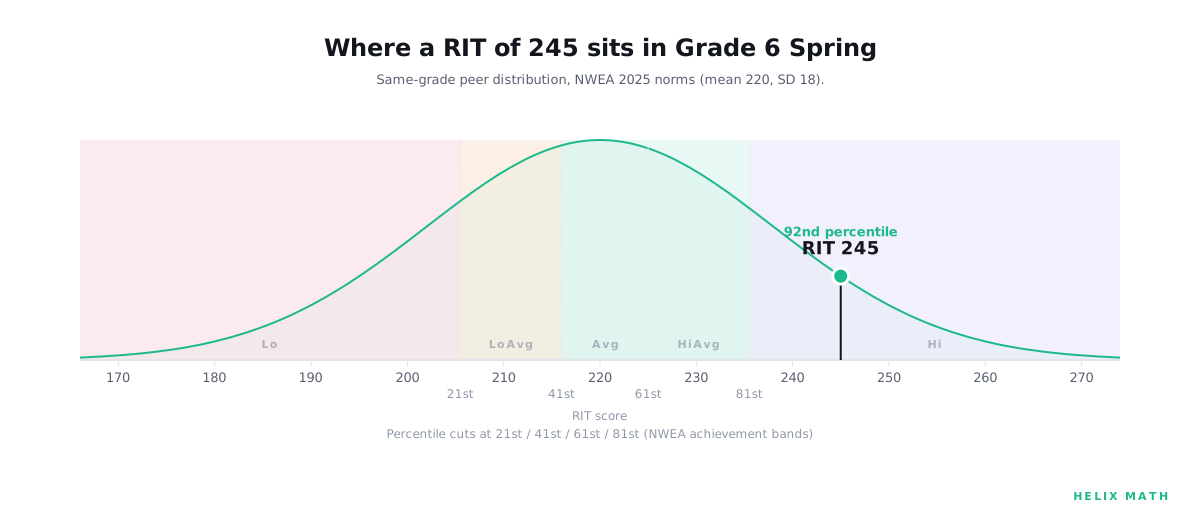
- A 245 is extremely high in elementary (often above the 95th percentile), closer to the low 90s by 6th-grade spring, and around the upper 70s to about the 80th by 8th-grade spring.
- The more useful question is not only "does this qualify?" but "what kind of advanced math is my child ready for next?" That readiness lives at a more granular level than one overall score.
What this score means by grade
A MAP math RIT of 245 sits at about the 90th percentile for grade 8 in fall, above the typical range for that grade (210 to 234). The same number means something different at every grade and season, which is what the table below shows.
| Grade | Fall | Winter | Spring |
|---|---|---|---|
| Grade 4 | 99th | 99th | 97th |
| Grade 5 | 99th | 97th | 95th |
| Grade 6 | 99th | 96th | 92nd |
| Grade 7 | 95th | 91st | 87th |
| Grade 8 | 90th | 84th | 79th |
A 245 sits at or above the 99th percentile for Grade 3 and below, so those grades are left out of the table above.
Percentiles are calculated from NWEA 2025 MAP Growth math norms (publicly published Quick Reference). A percentile says where a score sits against same-grade peers. It does not say which specific skills are secure and which need review; only a skill-level check can do that.
Is a 245 MAP math score gifted?
Parents often use "gifted" as shorthand for a child who seems ready for more. Schools use it as a formal program label. Those are not the same thing, and the gap between them explains most of the confusion around a high score. If you mean very high achievement next to same-grade peers, a 245 is often in that range, especially in the younger grades. If you mean official identification for a program, that depends on your district (more on it below).
A 245 is a high point on the RIT® scale, and what it means in percentile terms depends on grade and season. Here is where a 245 lands on the 2025 NWEA norms (rounded; exact percentiles depend on grade, season, and test timing) (NWEA 2025 MAP Growth Norms):
| Grade | Fall %ile | Spring %ile |
|---|---|---|
| 4 | about 99 | about 96–97 |
| 5 | about 97–99 | about 94–95 |
| 6 | about 97–98 | about 90–92 |
| 7 | about 94–95 | about 85–87 |
| 8 | about 89–90 | about 79–80 |
A 245 is extremely high in elementary school, often above the 95th percentile. By 6th-grade spring it is closer to the low 90s, and by 8th-grade spring it is around the upper 70s to about the 80th percentile. The score did not change. The grade-level context did. You can see that context for yourself in MAP math scores by grade, including typical 8th grade scores.
Through elementary school, a 245 often sits in the range many schools would treat as advanced or gifted-screening territory. By middle school the same score may still be very strong while no longer clearing a 95th-percentile cutoff. Either way, the test is measuring achievement on a broad math construct. It is not an IQ test, and a single sitting is a snapshot, not a verdict. The skills under the number are what a single score leaves open.
Why the school may not use the gifted label
A high MAP score may start the conversation. It does not always finish it.
Districts identify advanced learners in different ways:
- Some use national percentiles (a 90th, 95th, or 97th cutoff).
- Some use local norms: the top 10 percent within your building, which a 245 may not clear in a high-achieving school even at the 98th percentile nationally.
- Some require a cognitive or ability measure like the CogAT.
- Some weigh teacher input, portfolio work, or classroom performance.
- Some have no formal gifted label at all, or offer one only in certain grades or subjects.
None of that means the school is ignoring the score. The score is an achievement snapshot. The gifted label is a program gate built around a district's rules. They answer different questions, and when the school says nothing, the 245 is still real.
The better question: ready for what?
The label question has a yes-or-no feel. The more useful one is open-ended: what kind of advanced math is your child ready for next?
MAP samples broadly across math domains to estimate overall achievement. If your school shares instructional-area details, those can add useful context, but they still do not fully settle which advanced skills are secure and which need more evidence. Even at the top of the distribution, high scores can still compress differences underneath.
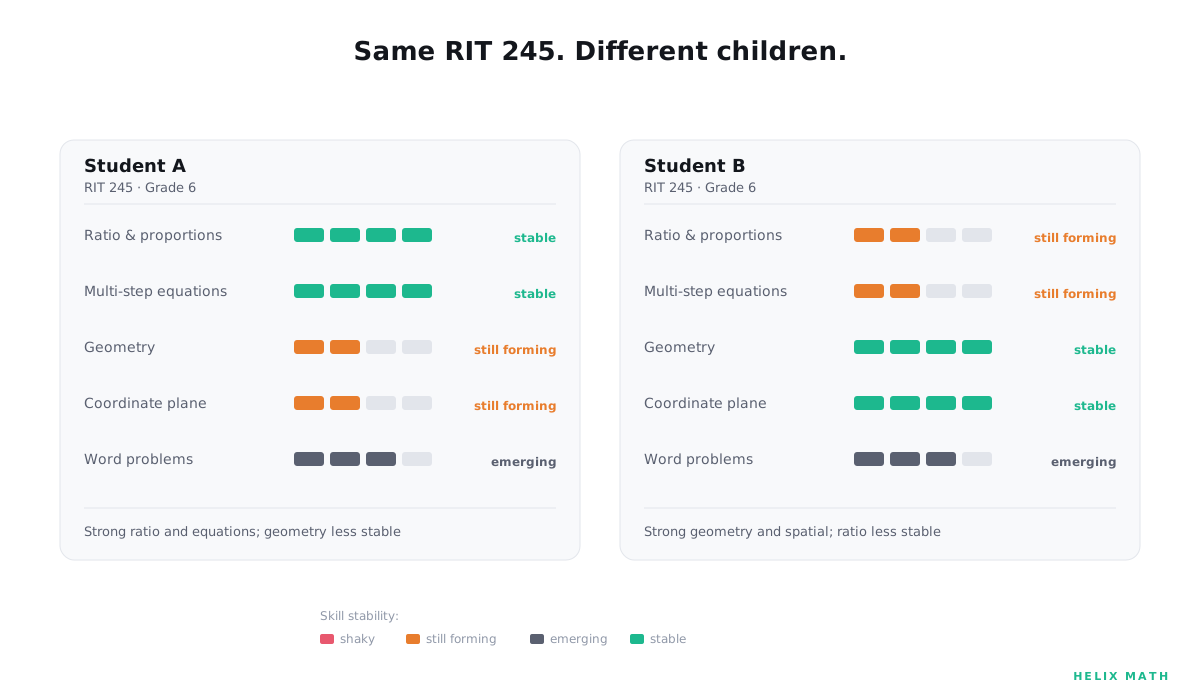
Picture two sixth graders, both at 245. Both likely need more challenge. They may not need the same challenge.
- Student A: strong ratio reasoning, unit rates, equation patterns, and multi-step numerical work (
6.RP.A.3); less secure with geometry, measurement, and coordinate-plane problems. - Student B: strong geometry and spatial reasoning; less secure with proportional relationships, translating word problems into expressions, and multi-step equation work (
7.EE.B.4).
The same score can point to very different next steps. That does not make the score wrong. It means the readiness question is more specific than the label question.
What you can do this week
A 245 is a strong start, not a finish line. Here is how to turn it into a plan.
1. Ask for the instructional-area breakdown. On the MAP report, look for uneven detail under the high overall score. If your school shares that level of information, the unevenness is where extra challenge will and will not land.
2. Ask what your school's advanced track actually requires. If acceleration or an advanced class exists, find out whether a 245 opens the door, or whether the district leans on a teacher recommendation or a separate test. A 245 is often enough to start the conversation.
3. Skip the pile of random "challenge" worksheets. A harder worksheet is not automatically a better challenge. If it repeats a strength, it may build speed more than depth. A child strong in ratio reasoning but less secure in geometry does not need harder ratio work; they need the geometry met where it is still developing.
4. Look at reasoning, not just answers. For an advanced child, the useful question is whether they can explain a method, adapt it when the problem changes, and carry it into a new context. That is what separates a deep 245 from a fast one.
If you want to see which advanced skills appear secure, which prerequisite pieces may still be developing, and where the next challenge should probably go, that is what Helix Math was built for. The Helix Program begins with a 30 to 40 minute diagnostic that returns a skill-level map, so you can aim the next challenge where it belongs. For the score band just below, see what a 230 means and when it opens the algebra-readiness conversation.
The number is high. Now find what it is ready for.
A 245 is strong evidence that your child is ready for more. Whether the school attaches a gifted label depends on rules that vary by district and grade. But the readiness underneath the number is the more important question: more of what? Faster computation, deeper problem solving, pre-algebra, geometry, proof, modeling, or something else entirely? The work ahead is not proving they are gifted. It is making sure the math keeps up with them.
MAP® and RIT® are registered trademarks of NWEA. Helix Math is not affiliated with or endorsed by NWEA.