Is my child on grade level in math? The honest answer
The teacher said it kindly, at the fall conference, in the same breath as "no concerns here." Your daughter is on grade level. You nodded, relieved. Then you drove home wondering why a child who is on grade level stares at a fractions worksheet like she has never seen one. She brings home solid report cards. She also counts on her fingers when she thinks you are not looking. If you have searched on grade level math and found only soft reassurance, here is the honest answer. A child can be on grade level and still have a fragile foundation. The label is real, but it answers a narrower question than the one you are actually asking. It tells you the altitude. It does not tell you whether the ground underneath is solid.
The short answer
- "On grade level" usually means your child scored at or near the median for their grade. It describes where they sit in a crowd, not a target they pass or fail.
- By definition, half of all students score below the median. Sitting a little under it is common, and it is not the same thing as being behind.
- The label tells you the altitude. It does not tell you which specific skills are stable and which are shaky underneath the score.
- Two children can carry the same grade-level label and have nearly opposite foundations. The average hides the gaps.
- Read on for the four different questions hiding inside "is my child on grade level," and which one actually matters.
On grade level is a comparison, not a diagnosis
Here is the part the conference never spells out. Schools mean several different things when they say a child is on grade level. Report cards, state tests, and classroom assessments all lean on the same basic idea: comparing your child to what is typical for their grade. A MAP® score is one common version, and it makes the logic especially visible, so we will use it as the example. The point holds whatever measure your school uses. "On grade level" is a comparison statement, not a skills checklist. It usually means your child landed at or near the middle for their grade and season, in the band that gets labeled average.
The median is the middle. Half of all students, in every grade, in every school, score below it. That is not a problem to be solved. It is just what a middle is. Grade level is not a finish line your child either clears or misses. It is a snapshot of where one child is standing inside a large group on one particular morning. You can see where most students land at each grade in the MAP RIT® score by grade chart.
A comparison is useful. It is also doing far less work than the word "level" implies. It places your child in the crowd. It says nothing about which parts of the foundation underneath that placement are ready for what comes next.
The four questions hiding inside "is my child on grade level in math?"
When a parent asks whether their child is on grade level, they are usually asking four different things at once. Pulling them apart is most of the relief.
- Where does my child sit relative to peers right now? The percentile answers this. A 52nd is squarely average. A 38th is in the lower-average band. Neither is a verdict.
- Is my child growing? A different question, and the status percentile cannot answer it. Growth is measured against where your child started, not against the crowd. A child can sit at the 45th percentile and be growing faster than nearly all of their peers. We pull this apart in growth, achievement, and rank.
- Does my child have gaps? This is where parents start to feel a little crazy. The report says fine. The homework says otherwise. The grade-level label is close to silent here, because a median score is an average of many skills, and an average can stay healthy while one skill underneath it stays shaky.
- Should I be worried? The honest answer is that it depends entirely on which of the first three you meant.
A MAP report is built in layers, and each layer is a lower resolution than the one below it.
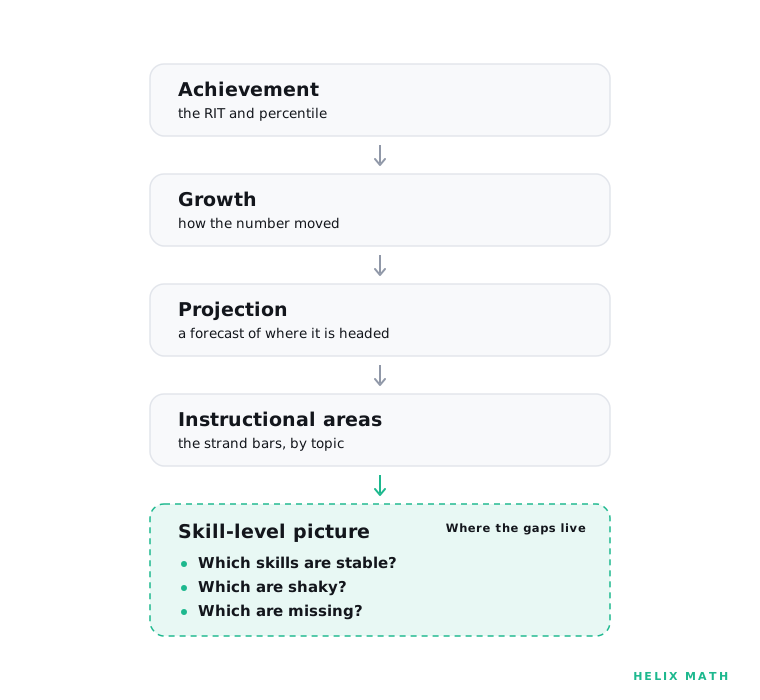
"On grade level" lives at the very top layer, and only roughly. Parents hear it as the answer to all four questions. It only answers the first.
Two children, same label, different foundations
Picture two sixth graders. Both score around the 50th percentile, a composite RIT of 220. Both come home with the same kind nod from the teacher: on grade level, no concerns.
Student A is strong in number and operations (fractions, decimals) but shaky in the algebraic-thinking strand, where ratios and proportional reasoning live. Student B is the mirror image: ratios come easily, fractions are still shaky. Same composite. Same label. Opposite foundations.
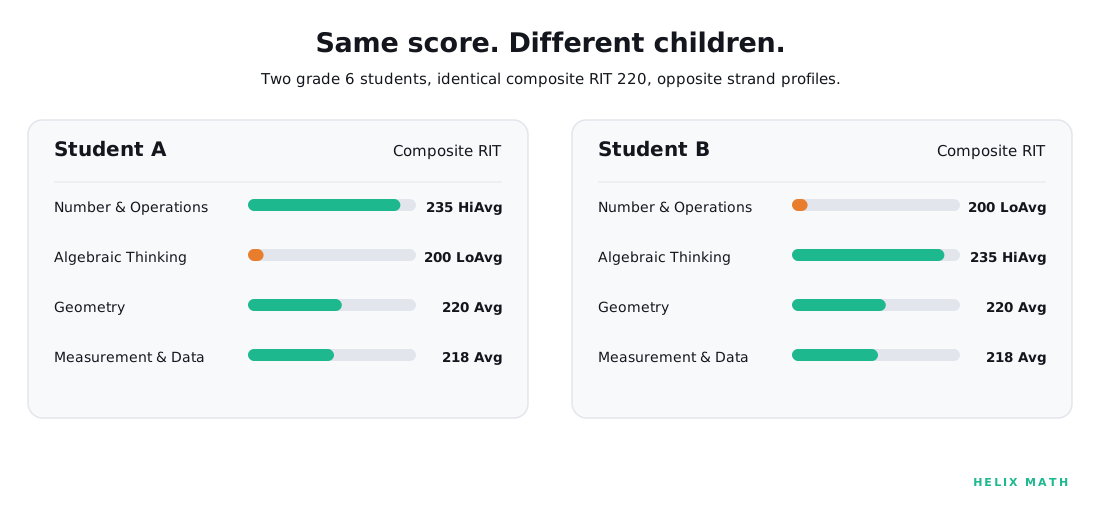
One of these children is positioned well for algebra. The other is carrying a hidden fault line. Proportional reasoning is the on-ramp to algebra, so the child who is shaky there will feel math get harder in seventh and eighth grade, while the label still reads "fine." The grade-level number cannot tell them apart. It was never built to.
This is why the average hides the gaps. A composite score is built to summarize, and summarizing means smoothing. A child who is strong in three strands and shaky in one can post a perfectly average number, because the strong areas quietly carry the shaky one. This article has a companion piece on exactly that mechanism: the average hides the gaps.
The strand bars on the report help a little, but each strand still spans dozens of skills. A lower number-sense bar could mean fraction equivalence, decimal place value or fraction operations needs review, or all three. The report shows the slope. It does not name the specific skill, the broader subject of what MAP scores don't tell you. As a loose rule of thumb, if one strand sits well below the others, by something like 10 points or more, across more than one testing window and matching what you see at home, that is worth a closer look. It is a place to start asking better questions, not a verdict. Finding it means looking at the specific skills, not the average sitting on top of them.
What you can do this week
Four concrete steps, in order.
Separate the status question from the growth question. "On grade level" and "growing well" are different facts. Ask the school for the Conditional Growth Percentile, which compares your child's growth to peers who started at the same place. A child at the 44th percentile with strong growth is not falling behind.
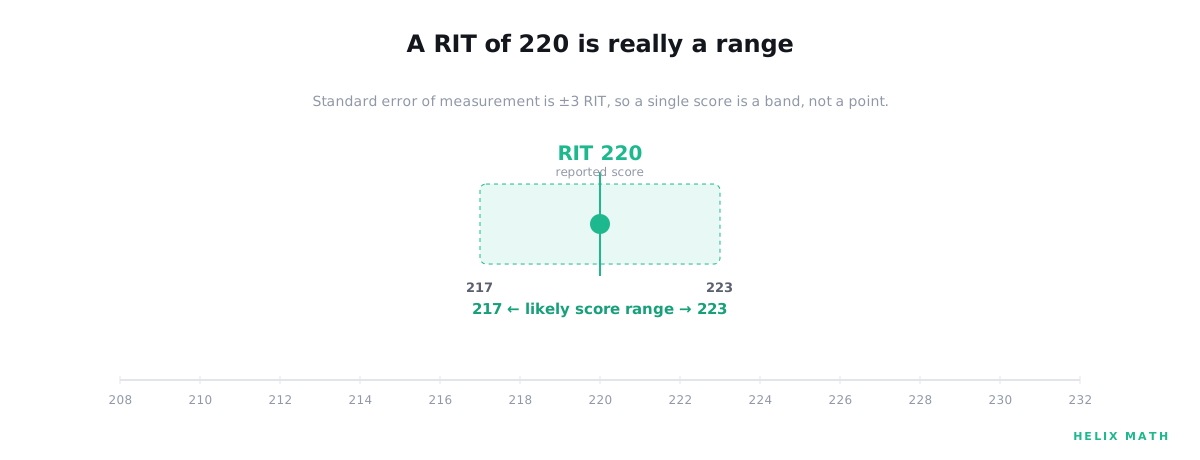
Ignore small movements around the median. A single MAP score carries about three RIT points of measurement error. A four-point dip that slides your child from the 51st to the 47th percentile is almost certainly noise.
Trust the pattern you see at home when it disagrees with the label. If the number says fine but your child melts down over the same kind of problem every week, the number is not wrong, just blunt. That repeated struggle is real data about a specific skill, and it is more actionable than a percentile.
If your child is not anxious, do not make them anxious by hovering over the number. A calm, average score on a calm, confident kid rarely needs a project attached to it. Watch the work, not the label.
Grade level answers a question you didn't ask
Parents rarely lie awake wondering whether their child is average. They lie awake wondering whether the foundation is solid. Grade-level labels answer the first question. They cannot answer the second.
Being on grade level means your child is near the middle of the distribution. It does not mean every part of the foundation underneath that score is ready for what comes next. Helix Math was built to answer the question the label cannot: which specific skills are secure, and which still need review underneath an average score. The Helix Program begins with a 30 to 40 minute diagnostic that turns the number into that map. For a faster first read, a free no-login practice check by grade shows where your child slows down in a few minutes: free grade 5 practice problems or free grade 7 practice problems.
Most parents are not trying to raise an average child. They are trying to understand the one they have. "On grade level" can be useful context. But when the label and the lived experience disagree, trust what you see at the kitchen table. Your child is not a crowd. The useful question was never whether they are average. It is which skills are secure, and which one to strengthen next.
MAP® and RIT® are registered trademarks of NWEA. Helix Math is not affiliated with or endorsed by NWEA.