Is 215 a Good MAP Math Score? 4th and 5th Grade Percentiles
Your daughter brought home her fall MAP® report. The math RIT® is 215. The teacher wrote "on grade level" in the comments. You Googled "215 MAP math score" three nights in a row because "on grade level" felt like a non-answer. She is in 5th grade, and fractions homework has been tears since September. To see where a 215 lands at every grade and season, see MAP math scores by grade, including typical 5th grade scores.
The short answer
- A 215 MAP math score in 4th grade is strong, about the 87th percentile in fall, dropping to roughly the 60th by spring as peers catch up.
- The same 215 in 5th grade is still above median in fall (~71st percentile) but slips to the 50th by spring. The number didn't move; the peers did.
- A 215 alone does not name which specific skills your child has and which still need review. Two students can score 215 for completely different reasons.
- For a 4th grader at 215, the question is whether they keep growing. For a 5th grader at 215, the question is which 5th-grade skills are still developing.
What this score means by grade
A MAP math RIT of 215 sits at about the 45th percentile for grade 7 in fall, inside the typical range for that grade (206 to 228). The same number means something different at every grade and season, which is what the table below shows.
| Grade | Fall | Winter | Spring |
|---|---|---|---|
| Grade 2 | 99th | 98th | 96th |
| Grade 3 | 97th | 92nd | 83rd |
| Grade 4 | 87th | 74th | 61st |
| Grade 5 | 71st | 57th | 48th |
| Grade 6 | 62nd | 48th | 39th |
| Grade 7 | 45th | 37th | 32nd |
| Grade 8 | 35th | 28th | 24th |
A 215 sits at or above the 99th percentile for Grade 1 and below, so those grades are left out of the table above.
Percentiles are calculated from NWEA 2025 MAP Growth math norms (publicly published Quick Reference). A percentile says where a score sits against same-grade peers. It does not say which specific skills are secure and which need review; only a skill-level check can do that.
What a 215 actually means in 4th grade
A 215 in 4th grade is not average. It is strong performance. Under NWEA's 2025 norms, the fall median for 4th grade math sits at RIT 197 (SD 16), placing a 215 near the 87th percentile. The median climbs to 204 by winter (215 ≈ 74th percentile) and 210 by spring (215 ≈ 61st percentile). The score did not change. The reference population did.
If your 4th grader scored 215 in fall, they are ahead of schedule, outperforming roughly 87% of same-grade peers in the national norming sample. "On grade level" understates the result. They are above grade level.
In skill terms, a 4th grader at this RIT typically handles multi-digit multiplication with the standard algorithm, identifies and compares simple fractions on a number line (Common Core 4.NF.A.1), reads decimals to tenths and often hundredths, and solves perimeter and area problems for rectangles with whole-number sides.
The question for a 4th grader at 215 is not whether they are behind. The question is whether they keep growing. Typical fall-to-spring growth in 4th grade is 13 RIT points (SD 8), per NWEA's growth norms. A 215 in fall should reach 222 to 228 by spring to track with peers. A 215 in fall and a 216 in spring is the flag, not the 215 itself.
What a 215 means in 5th grade, and why it's different
Same number, different reference population. The 5th-grade fall median is 206 (SD 16), so a 215 sits near the 71st percentile in fall. By winter the median climbs to 212 (215 ≈ 57th percentile). By spring the median is 216, and a 215 has settled to about the 48th. That is the grade-level middle (NWEA 2025 norms).
This is not a crisis. It is a drift. A student who was well above-grade-level in 4th grade is now tracking near the median by 5th grade spring. Peers gained more ground.
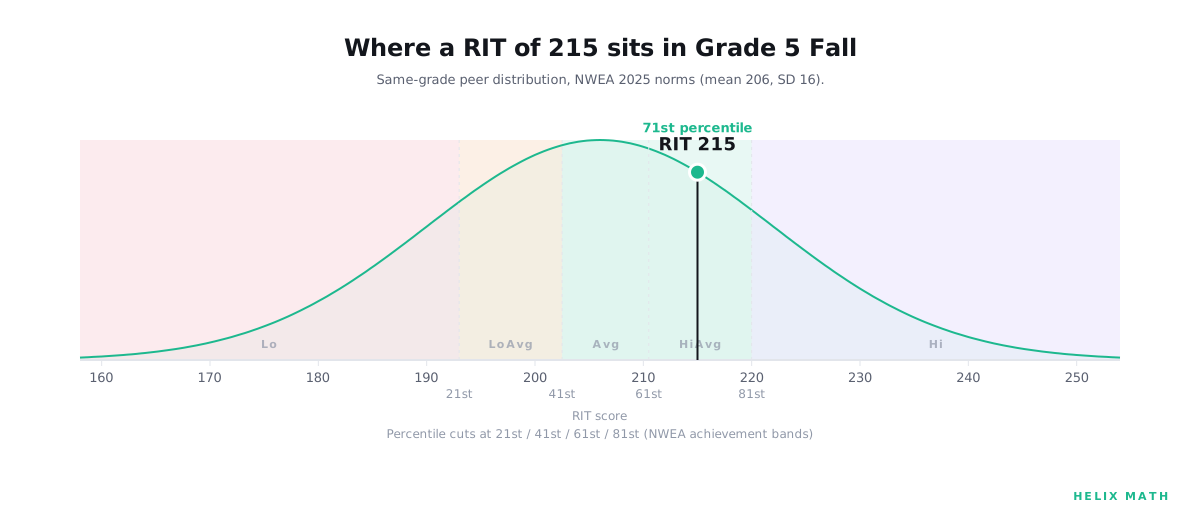
The drift usually means specific Common Core gaps are present. Fifth grade is when fraction operations move from identification to computation: adding fractions with unlike denominators (5.NF.A.1), multiplying a fraction by a whole number (5.NF.B.4). Place value with decimals expands to thousandths (5.NBT.A.3). Multi-step word problems require planning, not just calculation. If even one of these areas still needs review, growth stalls.
A 215 tells you the overall score. It does not tell you whether the gap is in fraction operations, decimal place value, or multi-step word problems. That distance between the number and the specifics is the whole subject of what MAP scores don't tell you.
The skills behind a 215, what's secure and what's still developing
A RIT of 215 corresponds to a Quantile range of roughly 680Q–780Q (per NWEA's published RIT-to-Quantile alignment), mapping to mid-4th through mid-5th instructional level. The RIT tells you what a MAP score actually measures: current skill on a broad math construct. It does not tell you which specific skills inside that range are secure.
Students at 215 have typically mastered whole-number operations through long division, simple fraction identification (halves, fourths, thirds on a number line), basic equivalence (2/4 = 1/2), bar-graph reading, and the perimeter and area of rectangles.
What likely still needs review at 215: fraction operations with unlike denominators, decimal place value beyond tenths, and multi-step word problems requiring unit conversions or proportional reasoning. A student at this RIT can usually identify 3/4 on a number line but may not fluently compute 1/3 + 1/4 without a visual model. They may be able to solve a one-step word problem instantly and stall on a two-step.
A common parent misconception is "my child knows fractions" when the child can identify 3/4 but cannot compute 2/3 + 1/6. Identification is a 3rd-grade skill. Operations are 5th. The MAP score does not distinguish between them.
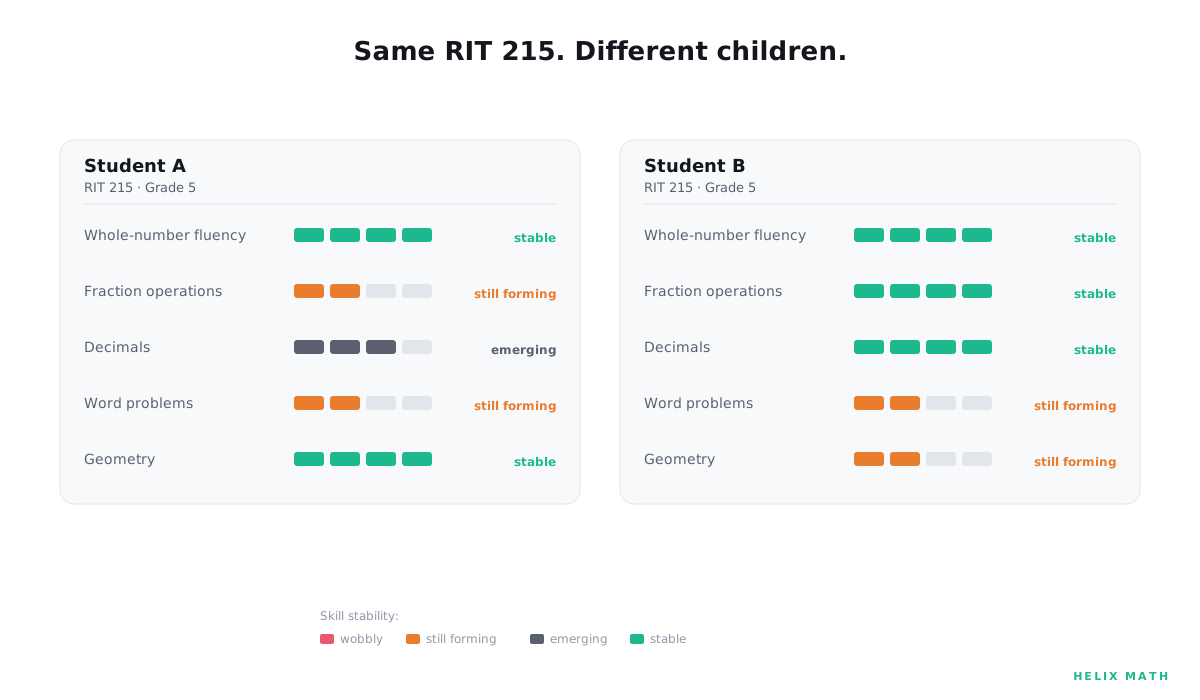
The same 215 can mean two completely different children.
What you can do this week
Three actions, grade-specific.
For 4th graders at 215. Focus on enrichment and growth-rate. Practice multi-digit division (4.NBT.B.6) until the algorithm is automatic. Work fraction equivalence with unlike denominators (4.NF.A.1) by reasoning about size of parts, not cross-multiplying. Introduce two-step word problems that require deciding which operation to do first. Aim for 222–228 by spring. That range lets your child enter 5th grade ready to take on fraction operations without needing to review the earlier skills first. To see where those skills sit today, the free grade 4 MAP math practice problems run fourteen questions in about fifteen minutes, with no sign-up.
For 5th graders at 215. Focus on the two or three skills that still need review. Practice fraction operations: adding and subtracting unlike denominators (5.NF.A.1), multiplying a fraction by a whole number (5.NF.B.4). Practice them until they no longer need a model. Work decimal place value to thousandths (5.NBT.A.3). Minimum goal: 220 by spring. Ideal: 225. That range protects 6th-grade ratio and proportion readiness. The free grade 5 MAP math practice problems sample those fraction and decimal skills in fourteen questions, and tell you which ones came out clean.
For both grades. Check the Student Profile Report for rapid-guessing flags. If more than 30% of items were rapid-guessed, the 215 may underestimate true ability and a retest is warranted (NWEA administration guidance). A score deflated by disengagement is not the same as a score reflecting gaps.
If you want to see which specific skills your child has secured and which are still developing, Helix Math is built around exactly that. The Helix Program begins with a 30 to 40 minute diagnostic that maps the underlying skills one at a time.
When 215 becomes a problem, and when it doesn't
A 215 is a starting point. Whether it becomes a problem depends on what happens next.
If your 4th grader scores 215 in fall and 216 in spring, that is the red flag. They gained 1 RIT point when typical growth is 13. Peers gained ground. Your child did not. The 215 was fine. The stall is not.
For a 5th grader, the marker is whether the score stays at 215 across two windows. A 215 in fall and a 215 in winter means peers gained an average of 6 points while your child gained zero. Stalled growth in 5th grade is rarely about effort. It is about missing foundational skills that prevent new learning from sticking. This is often why a MAP score can drop even when a student is learning: the test samples harder items each season, and the foundational gaps make those items inaccessible.
Conversely: a 4th grader at 215 in fall and 227 in spring is growing faster than peers and likely headed toward advanced math placement. A 5th grader moving from 215 to 225 is on the same trajectory. That is above-median growth, indicating strong instruction, strong home practice, or both.
The MAP report shows a 215 and a percentile. The skill-level picture (which of the fifteen foundational 5th-grade skills your child has and which are missing) lives at a different resolution than the report was designed to measure. The RIT anchors the level. The percentile anchors the standing. Neither names the skill.
The 215 did not define your child's math ability. It named a starting point. The next MAP test will tell you whether that starting point became a platform for growth or a place where your child got stuck. Find the skills that need review now, before the gaps carry forward into middle school.
The fractions homework that brought you here at 9pm is not about effort. It is about two or three specific missing pieces that can be found and repaired.
MAP® and RIT® are registered trademarks of NWEA. Helix Math is not affiliated with or endorsed by NWEA.